3D-Printed Composite Sandwich Facade
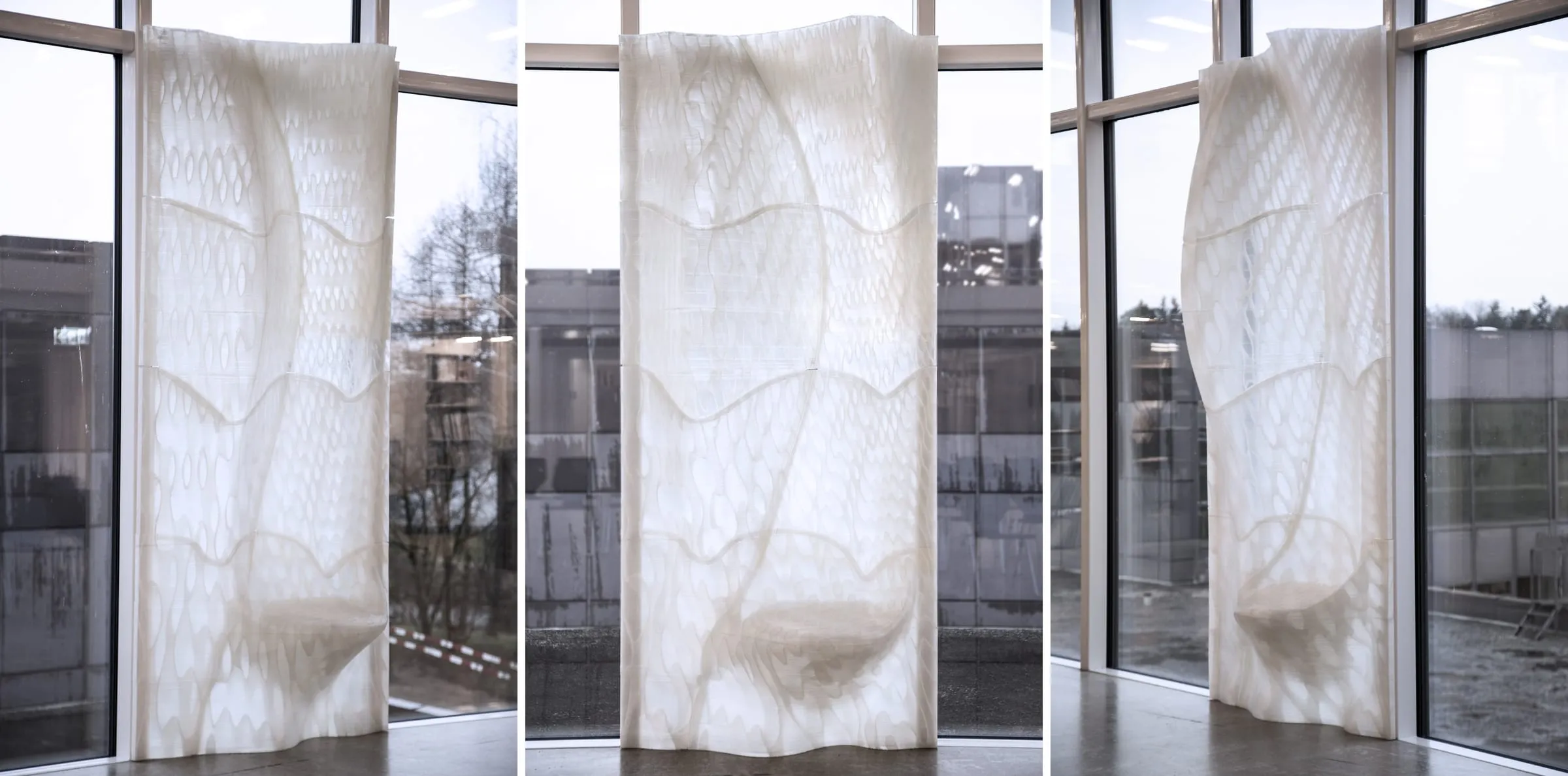
A large-scale, freeform composite sandwich element produced without moulds by 3D printing, with core geometries and insulating foams that grade insulation and translucency across the panel. MAS ETH DFAB thesis, published at CAADRIA 2020.
- Year
- 2019
- Location
- ETH Zürich, Switzerland
- Institution
- ETH Zürich: Digital Building Technologies, MAS ETH in Architecture and Digital Fabrication
- Collaborators
- Yoana Taseva, Hyunchul Kwon (tutor), Matthias Leschok (tutor), Benjamin Dillenburger
- Category
- Large-Scale 3D Printing, Computational Design, Material Research, Prototypes and Demonstrators
- Role
- MAS ETH DFAB thesis project with Yoana Taseva
Project
Foam-cored sandwich panels have a high strength-to-weight ratio and therefore allow large structural spans and cantilevers. Conventional fabrication methods work efficiently for standard geometries, but for complex, bespoke shapes they become time, cost and labour intensive.
Extrusion-based 3D printing offers freedom in the design of non-standard geometries, uses material efficiently and allows mould-less fabrication with little manual labour. Building on these advantages, this Master’s thesis in the MAS ETH in Architecture and Digital Fabrication set out to produce a large-scale, freeform composite sandwich element. It was developed with Yoana Taseva, tutored by Hyunchul Kwon and Matthias Leschok at Digital Building Technologies, and published at CAADRIA 2020.
Approach
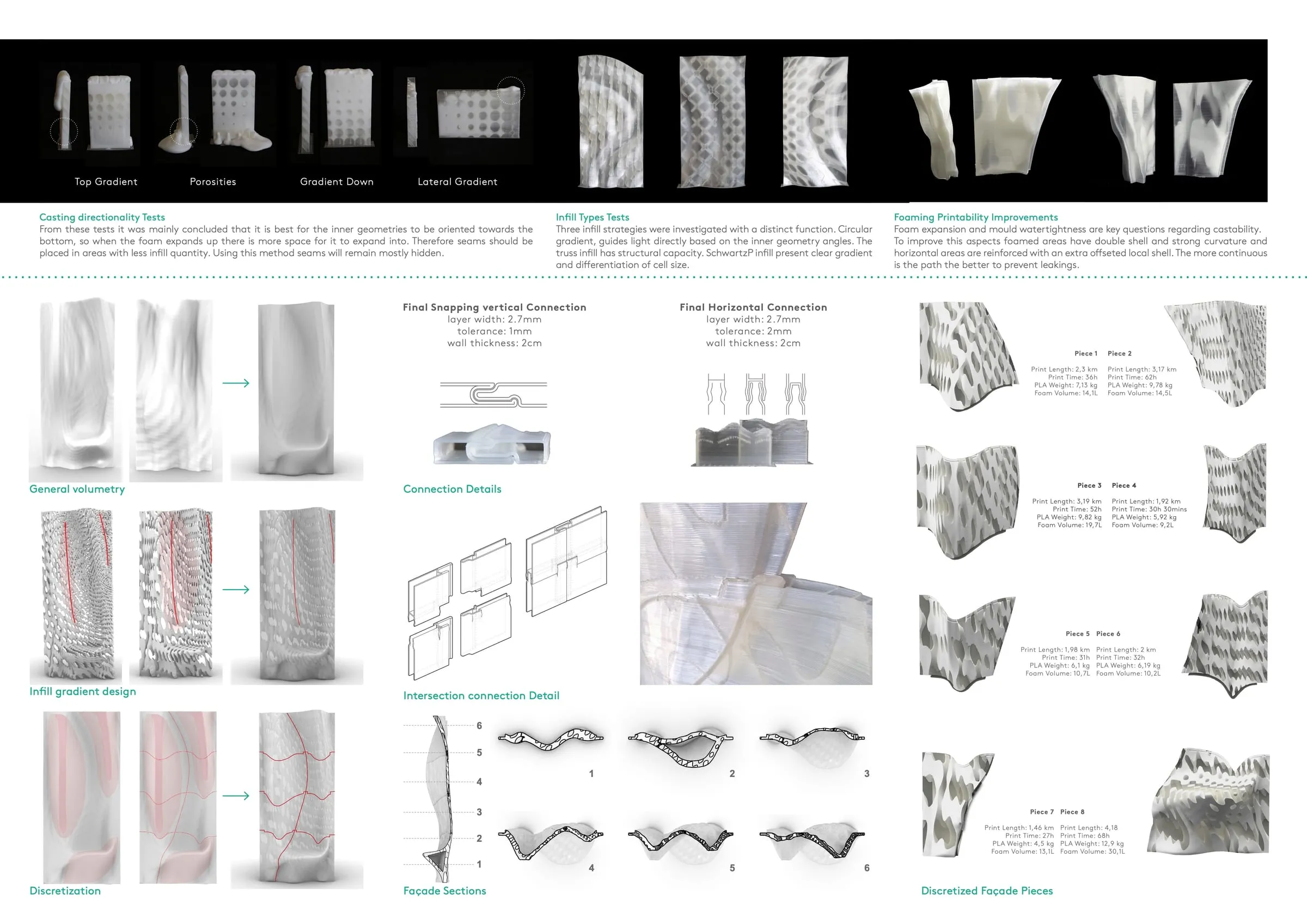
The research first investigated insulating foams and internal core geometries that integrate functions into the panel, in particular gradients of insulation and translucency. The element was then discretised into printable pieces, each with its own graded core, and joined through connection details designed for assembly.
Tests
Casting directionality tests showed that the inner geometries work best when oriented towards the bottom, so that the expanding foam has room to rise into them. Seams were therefore placed in areas with less infill, where they remain mostly hidden. Three infill types were investigated, each with a distinct function: a circular gradient that guides light according to the angles of the inner geometry, a truss infill with structural capacity, and a Schwarz P infill with a clear gradient and differentiation of cell size.
Foaming and printability
The printed shells act as moulds for the foam core, so foam expansion and the watertightness of the mould were key to castability. To improve both, the areas to be foamed have a double shell, and areas with strong curvature or horizontal surfaces are reinforced with an additional, locally offset shell. The more continuous the print path, the lower the risk of leakage.
| Piece | Print length | Print time | PLA weight | Foam volume |
|---|---|---|---|---|
| 1 | 2.30 km | 36 h | 7.13 kg | 14.1 L |
| 2 | 3.17 km | 62 h | 9.78 kg | 14.5 L |
| 3 | 3.19 km | 52 h | 9.82 kg | 19.7 L |
| 4 | 1.92 km | 30.5 h | 5.92 kg | 9.2 L |
| 5 | 1.98 km | 31 h | 6.10 kg | 10.7 L |
| 6 | 2.00 km | 32 h | 6.19 kg | 10.2 L |
| 7 | 1.46 km | 27 h | 4.50 kg | 13.1 L |
| 8 | 4.18 km | 68 h | 12.90 kg | 30.1 L |
| Total | 20.2 km | 338.5 h | 62.3 kg | 121.6 L |
Connections
The pieces are joined through connections printed directly into their edges, so that the element can be assembled without additional fasteners. Both final connections were printed with a layer width of 2.7 mm and a wall thickness of 2 cm:
- Vertical connection: a snapping joint with a tolerance of 1 mm between the mating parts.
- Horizontal connection: a joint with a tolerance of 2 mm.
Publications
- Taseva, Y., Eftekhar, N., Kwon, H., Leschok, M., & Dillenburger, B. (2020). Large-scale 3D printing for functionally graded facade. CAADRIA 2020: RE:Anthropocene (pp. 183–192), Bangkok. doi:10.52842/conf.caadria.2020.1.183