Glatsch
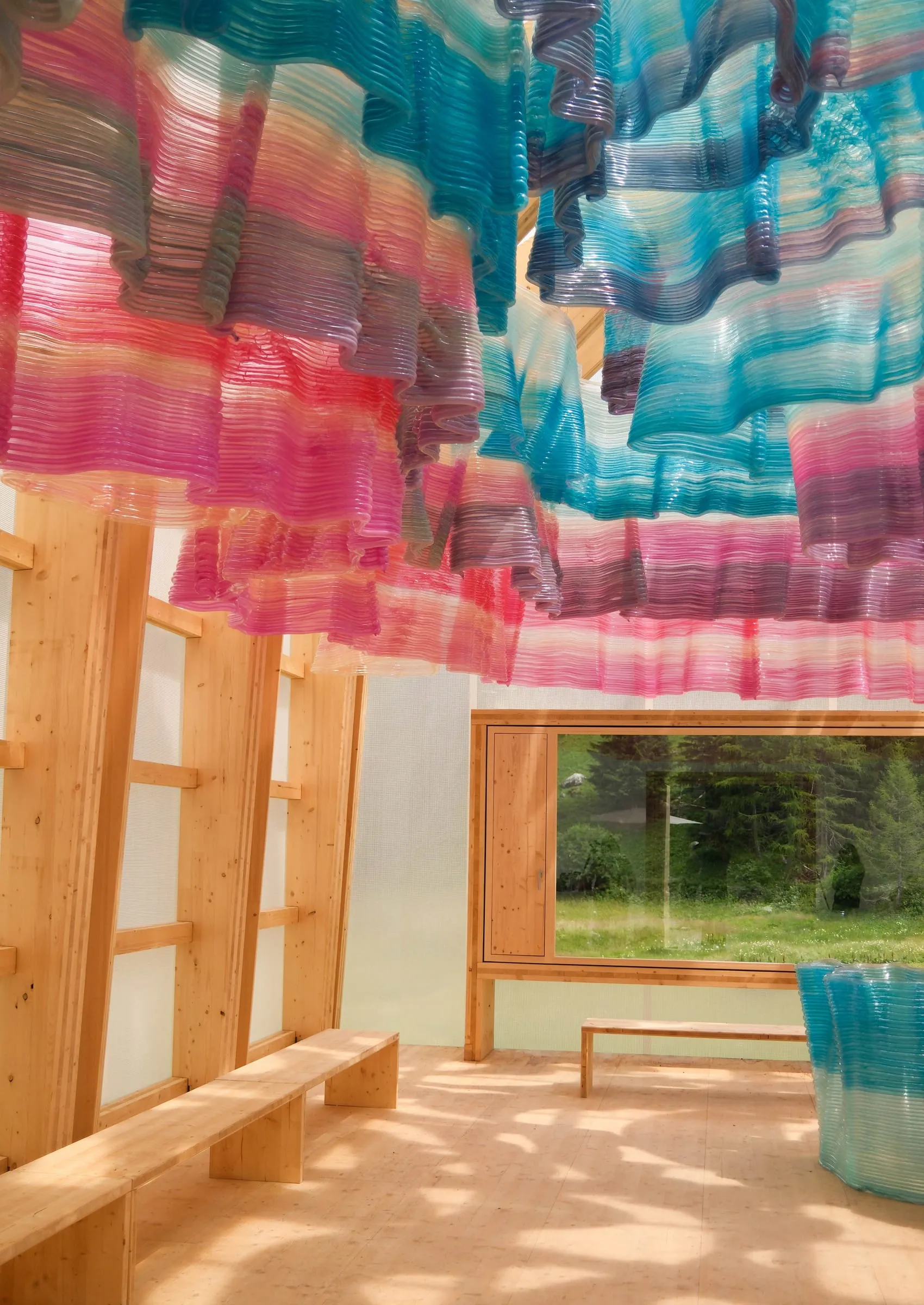
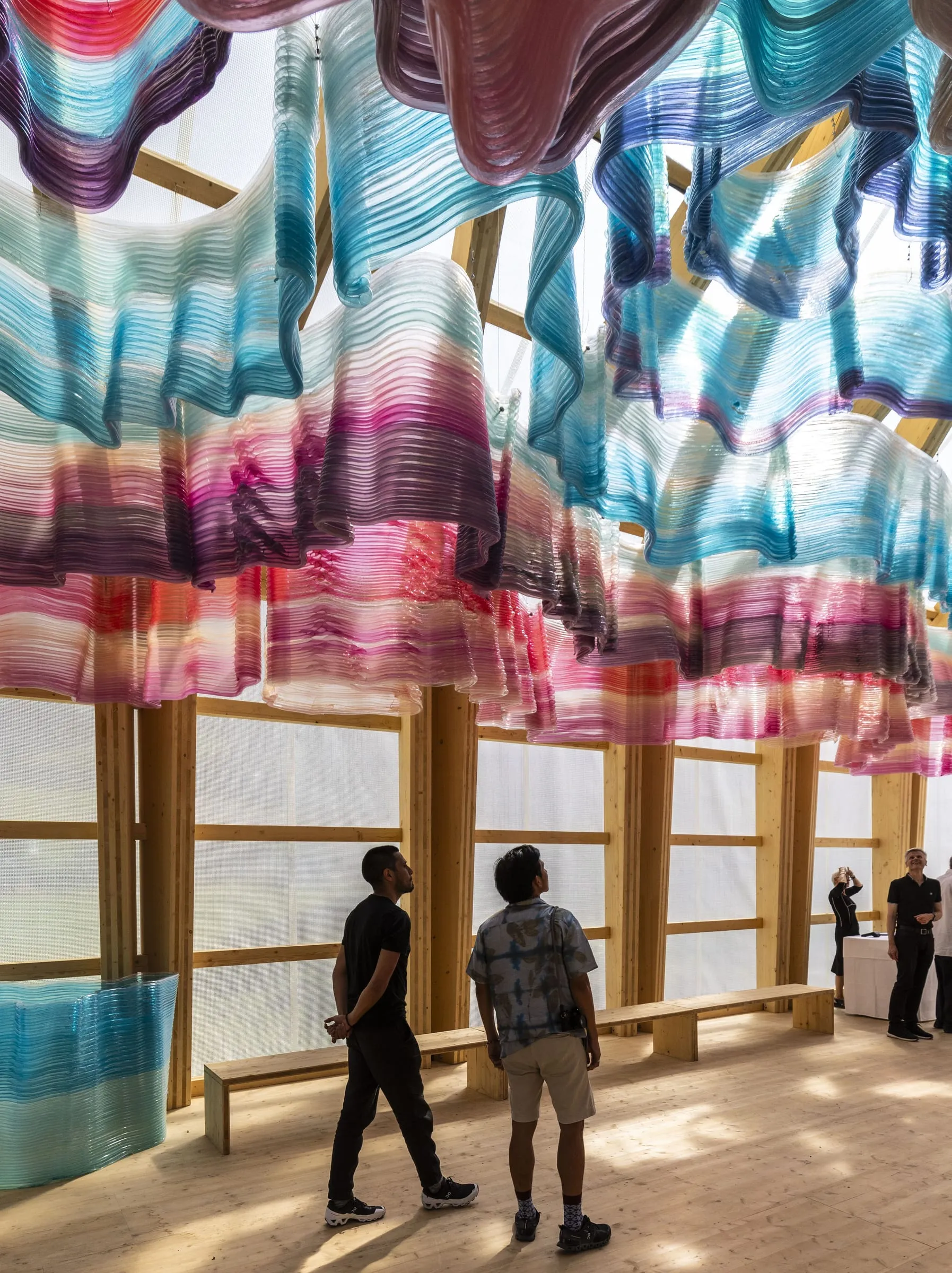
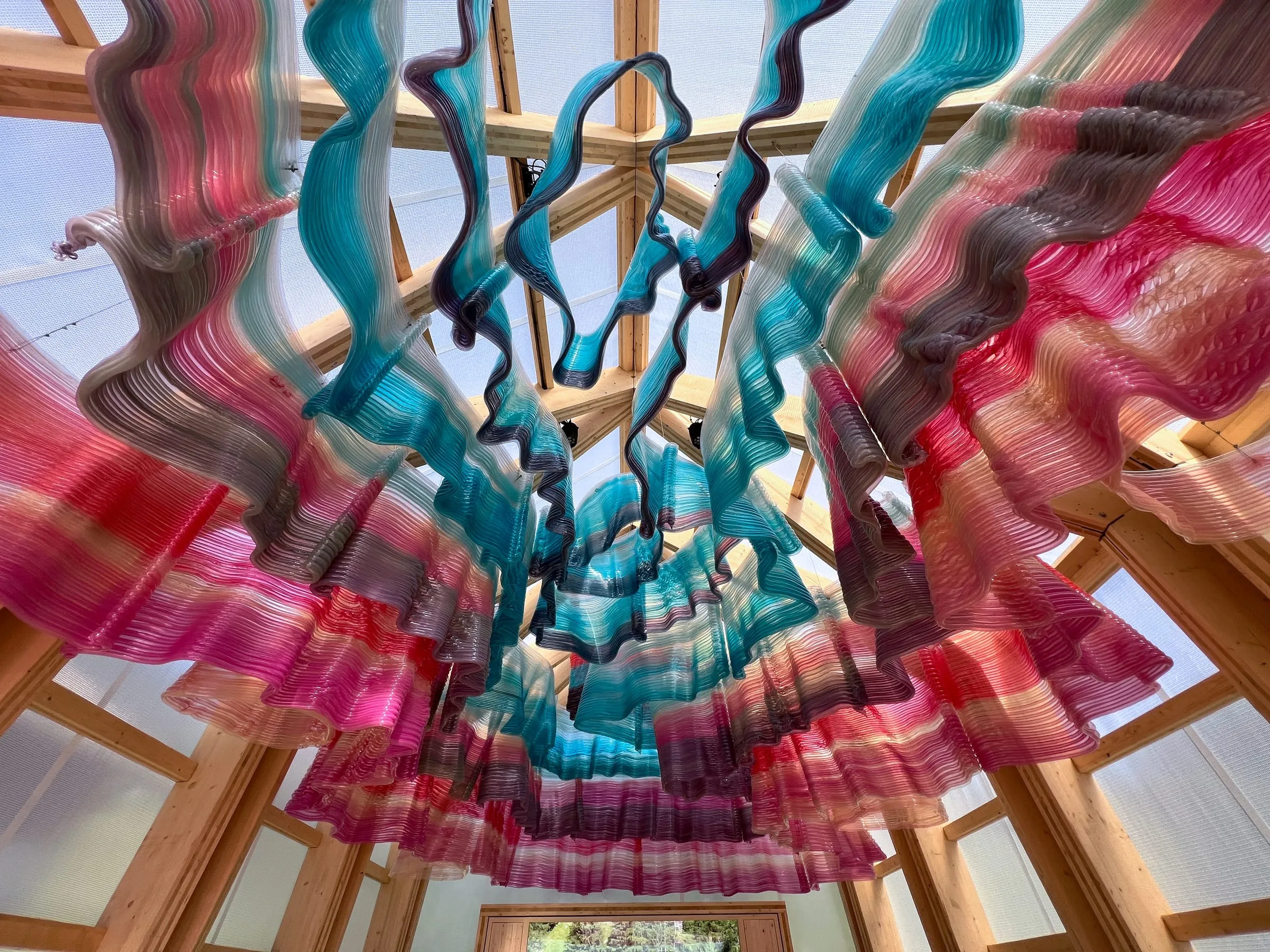
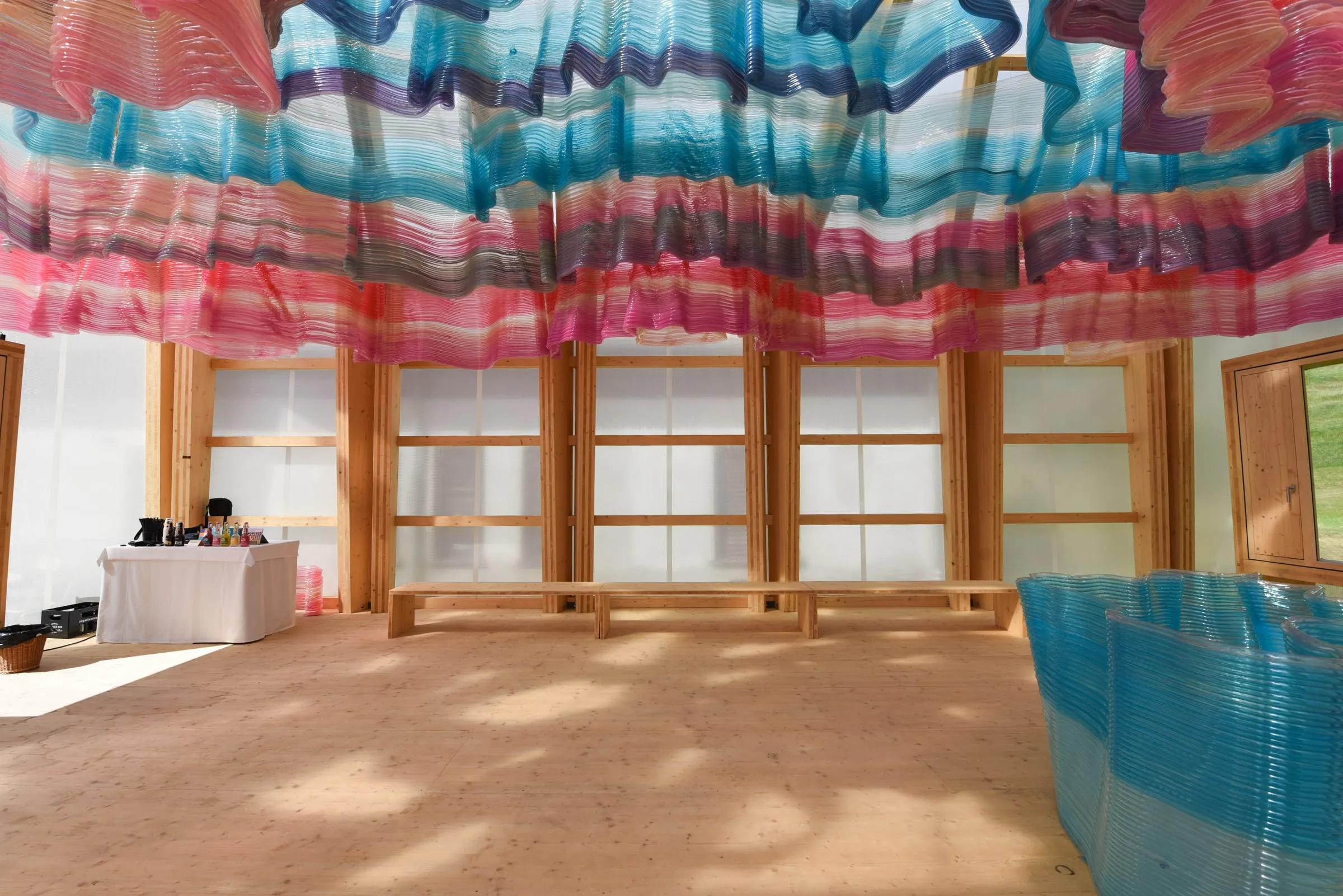
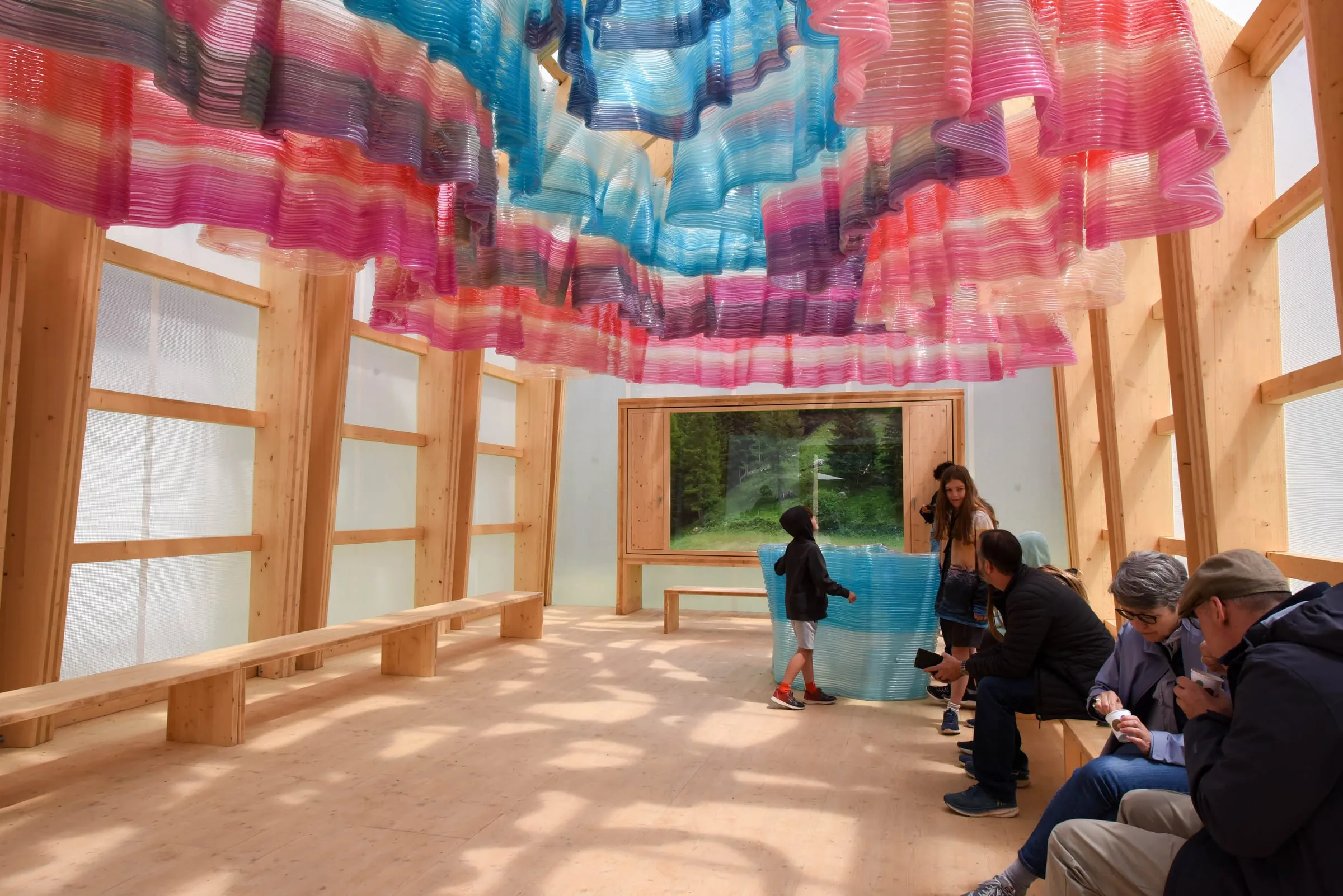
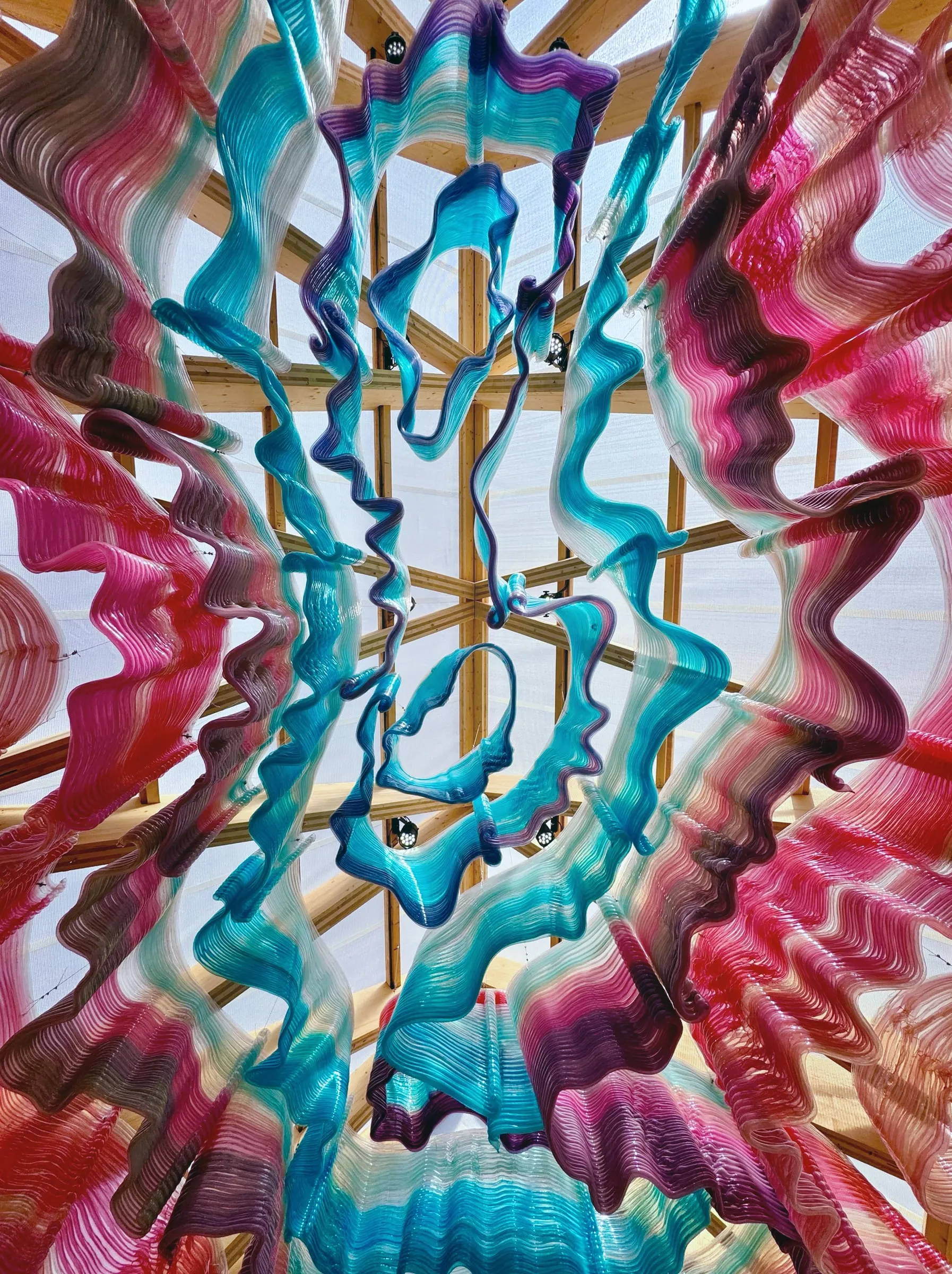
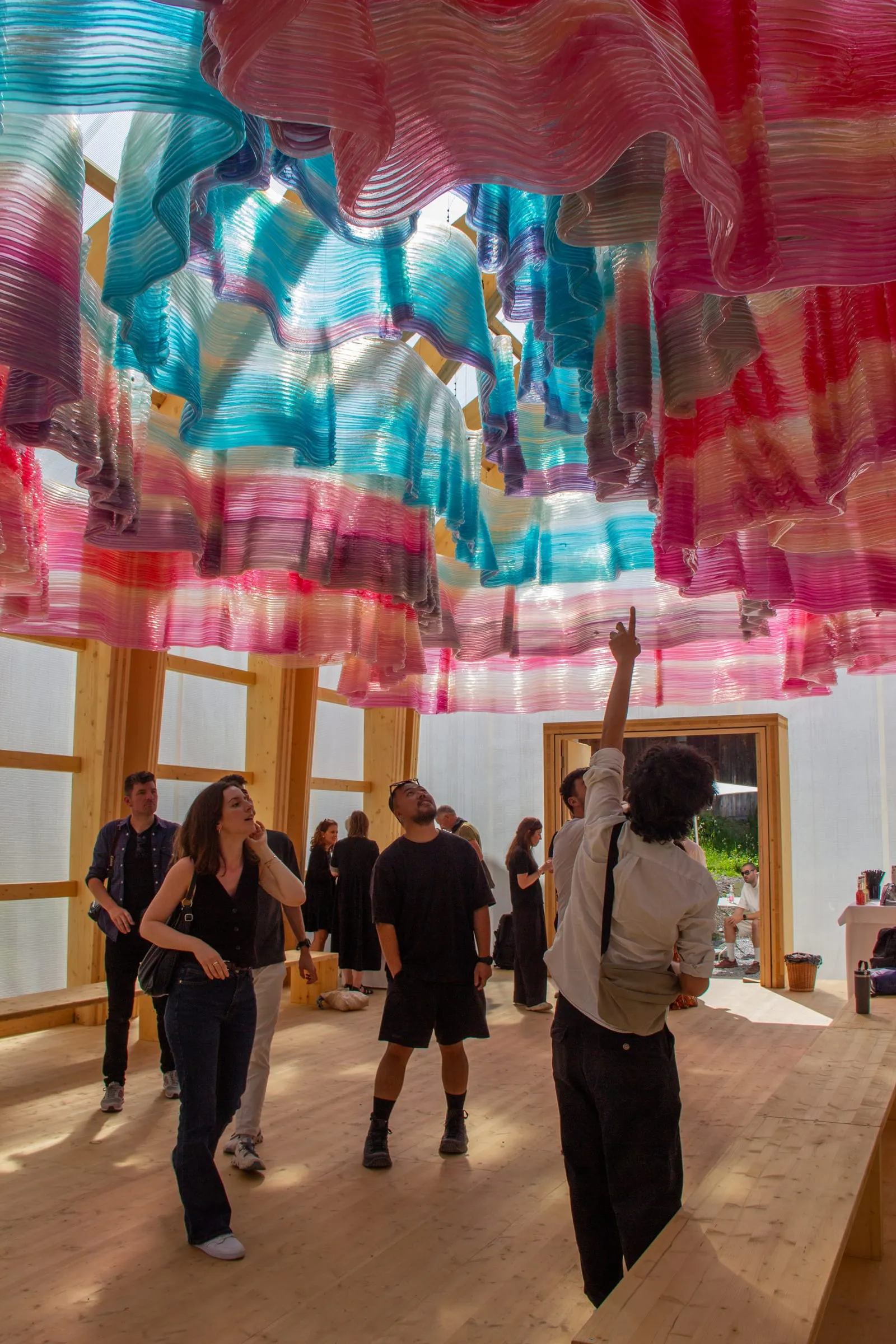
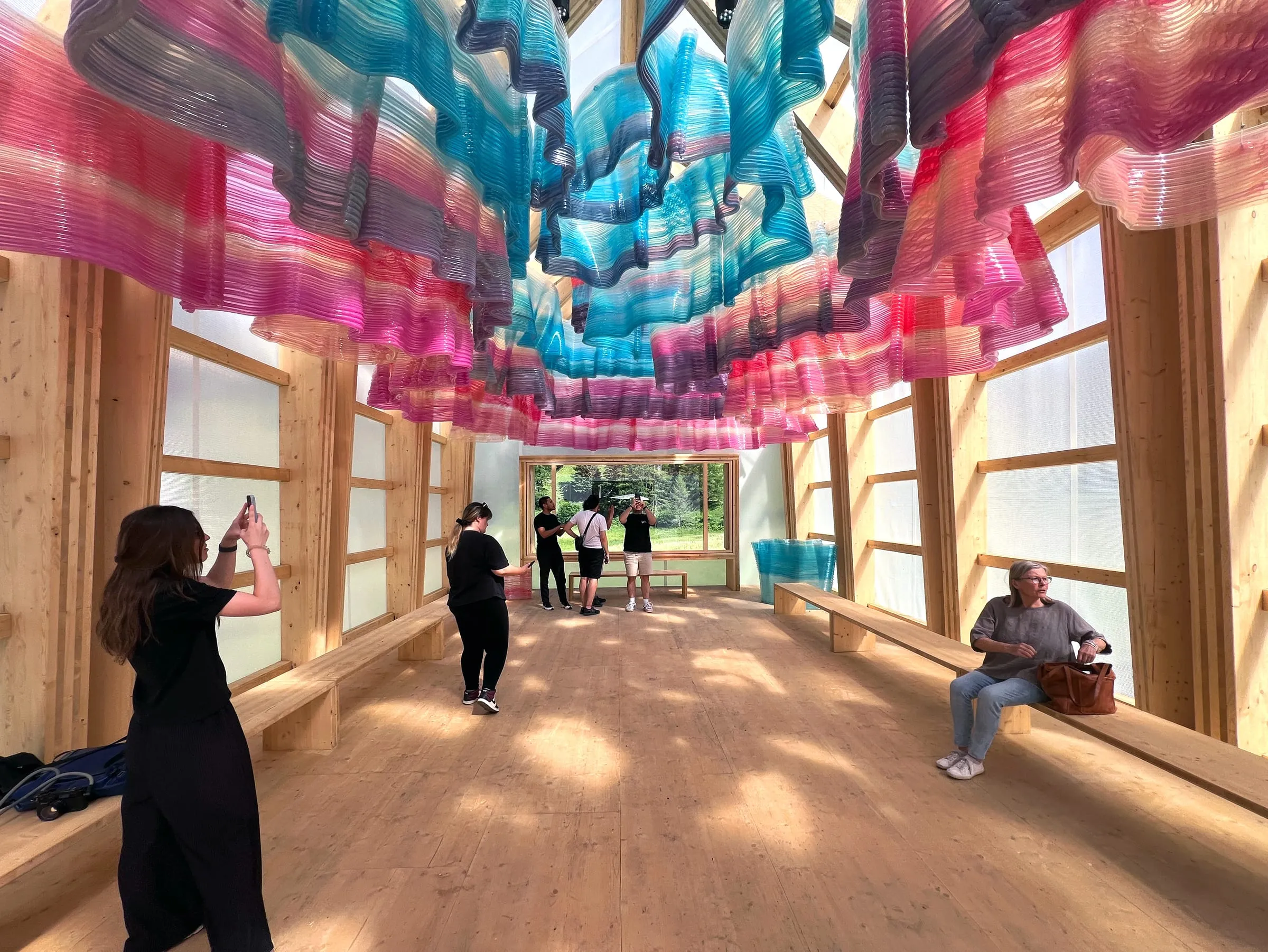
A demountable pavilion and ice-cream kiosk in the Alpine village of Mulegns. A cupola of 54 coloured Hollow-Core 3D-printed panels in recycled PETG is suspended within a cross-laminated timber structure.
- Year
- 2025
- Location
- Mulegns, Grisons, Switzerland
- Institution
- ETH Zürich: MAS ETH DFAB and Digital Building Technologies
- Client
- Nova Fundaziun Origen
- Collaborators
- Petrus Aejmelaeus-Lindström, Ananya Kango, Joana Tomaz, Paul Jaeggi, Benjamin Dillenburger
- Category
- Large-Scale 3D Printing, Robotic Fabrication, Prototypes and Demonstrators, Computational Design
- Role
- Research lead, Digital Building Technologies
Project
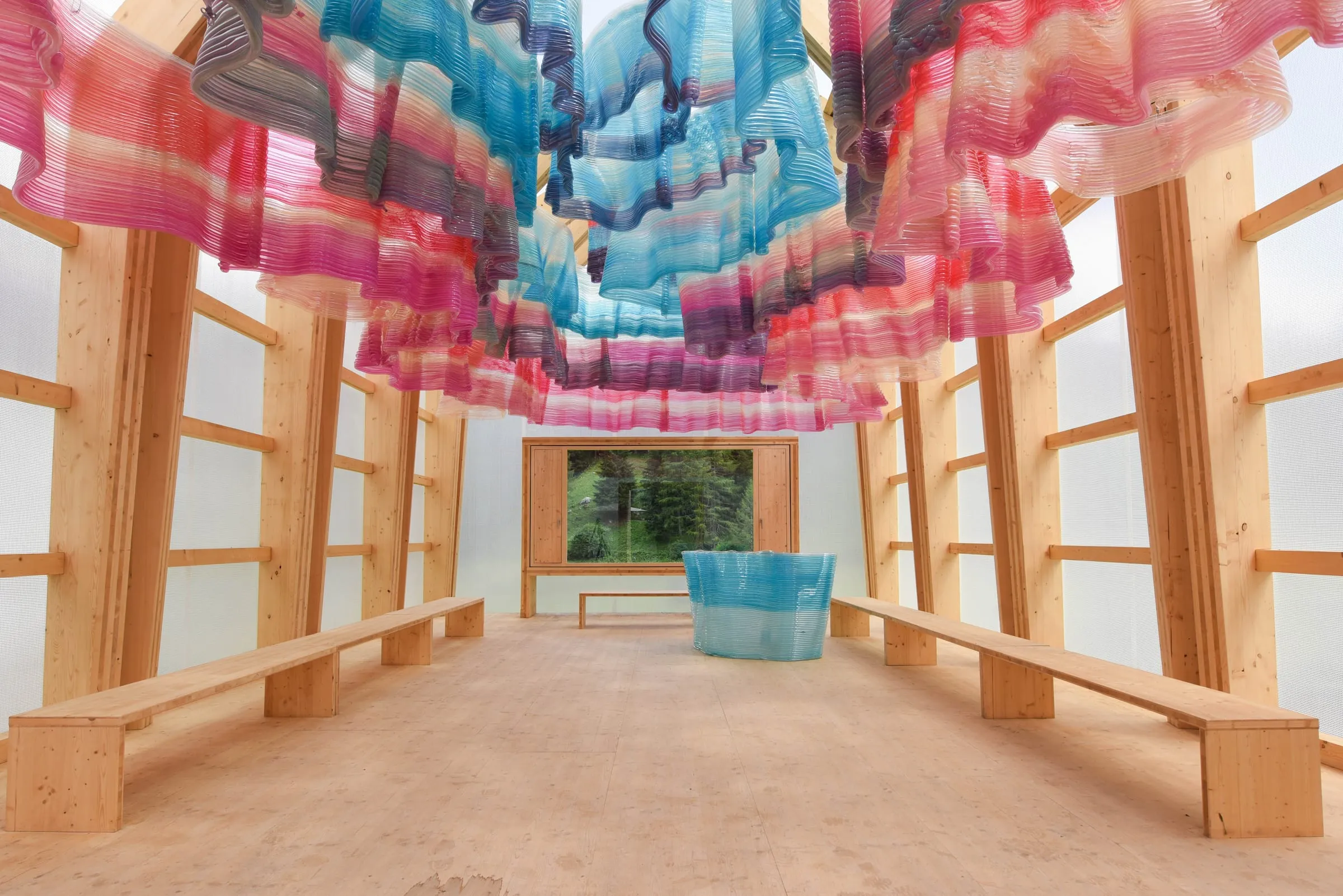
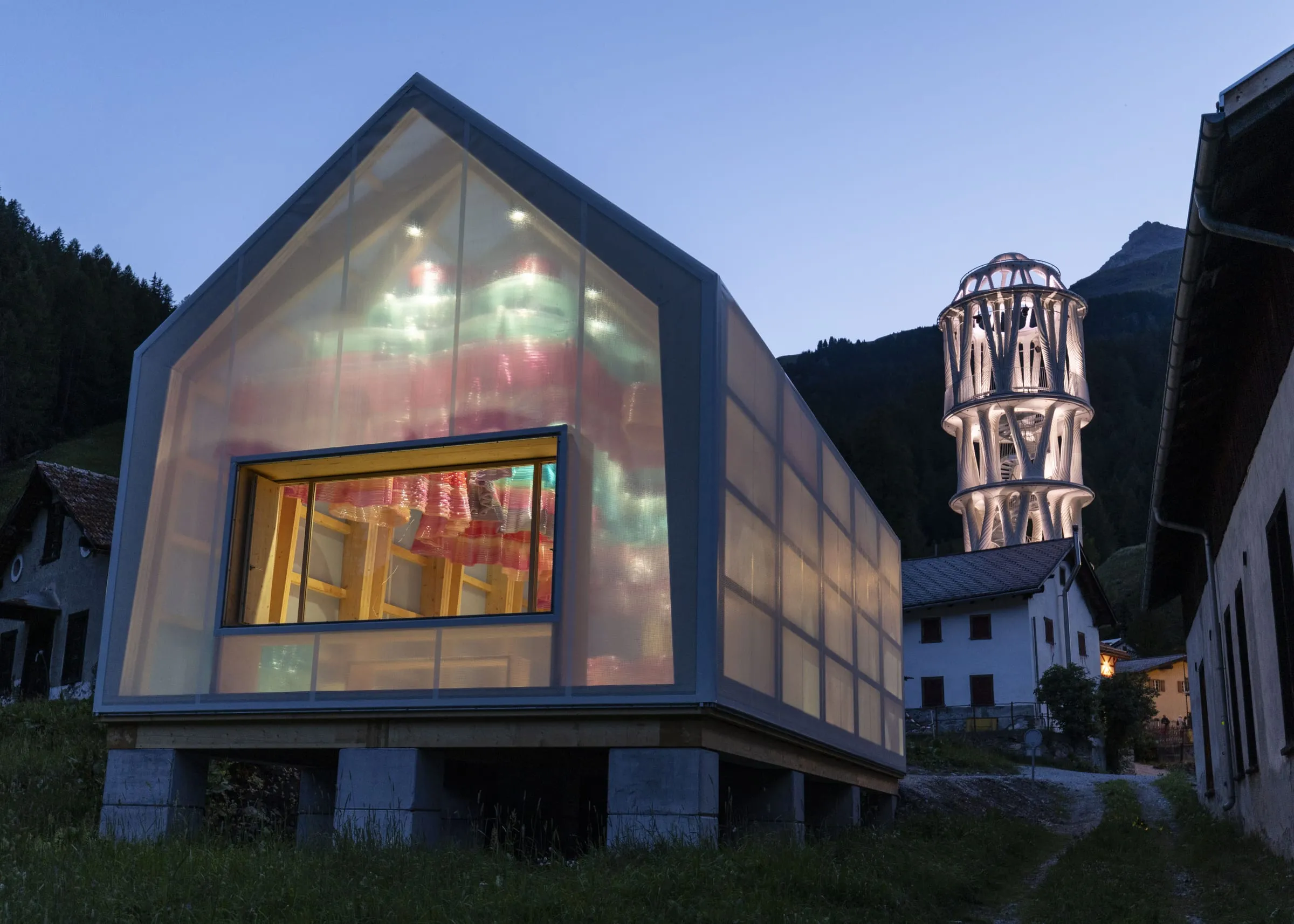
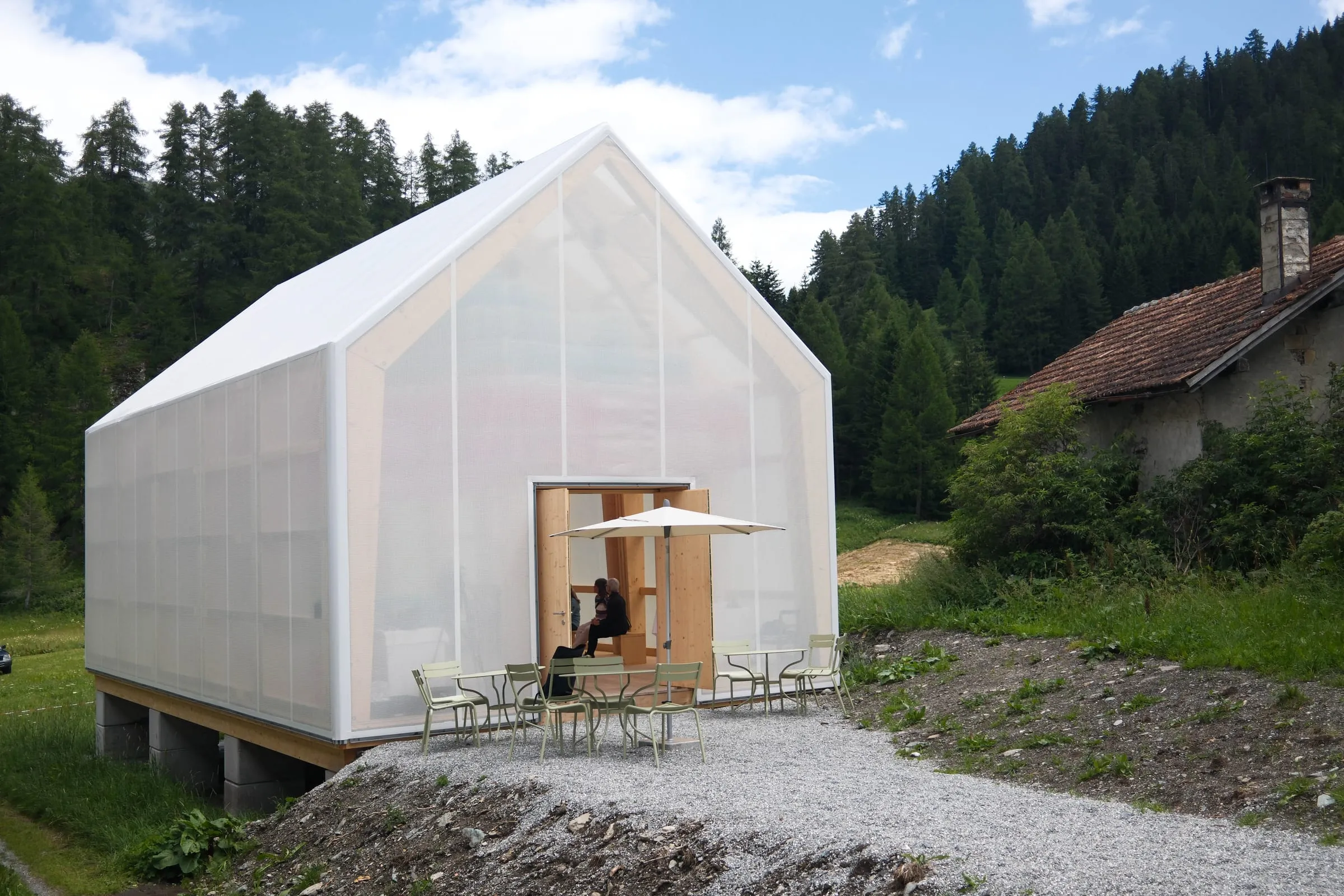
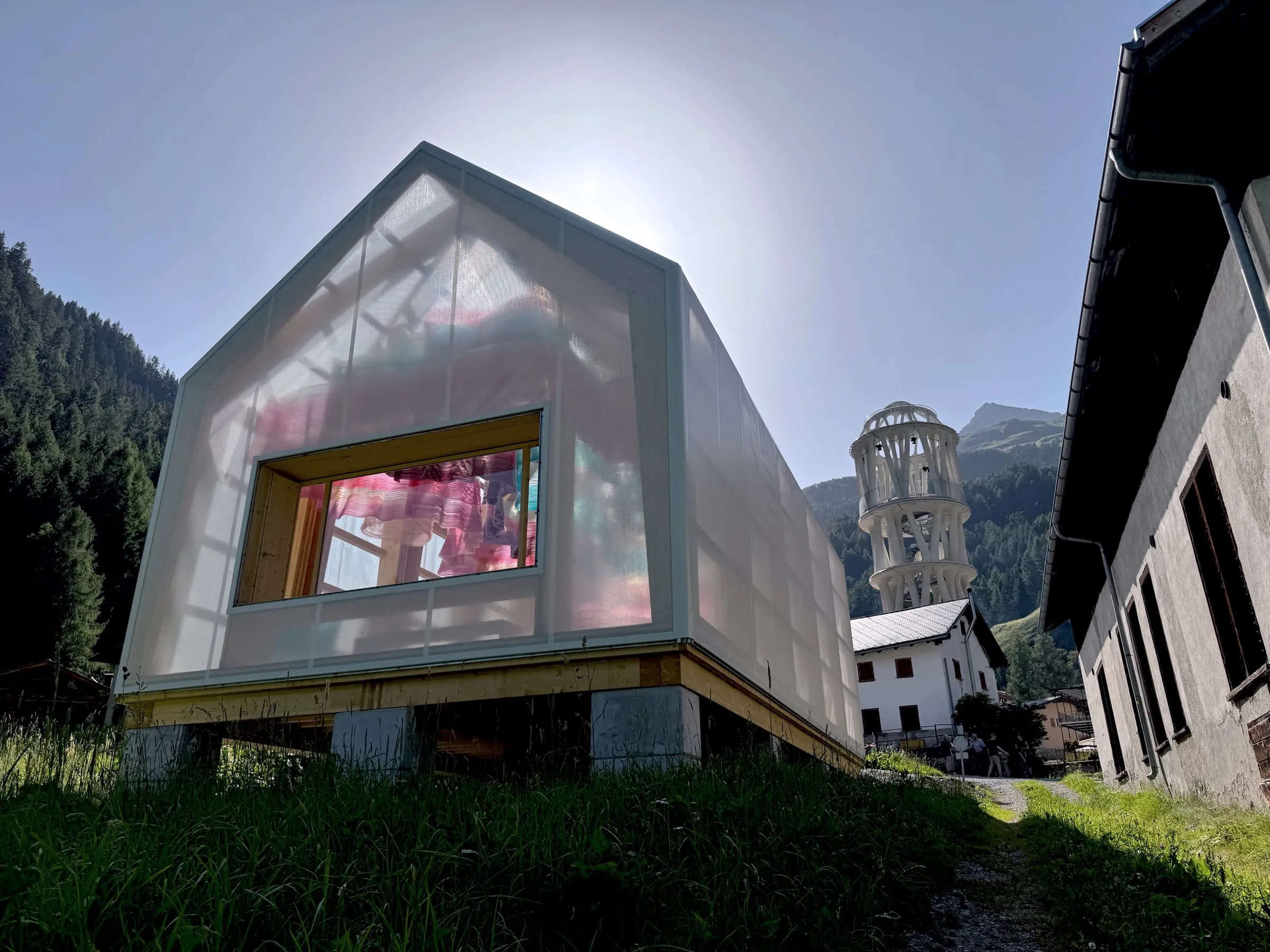
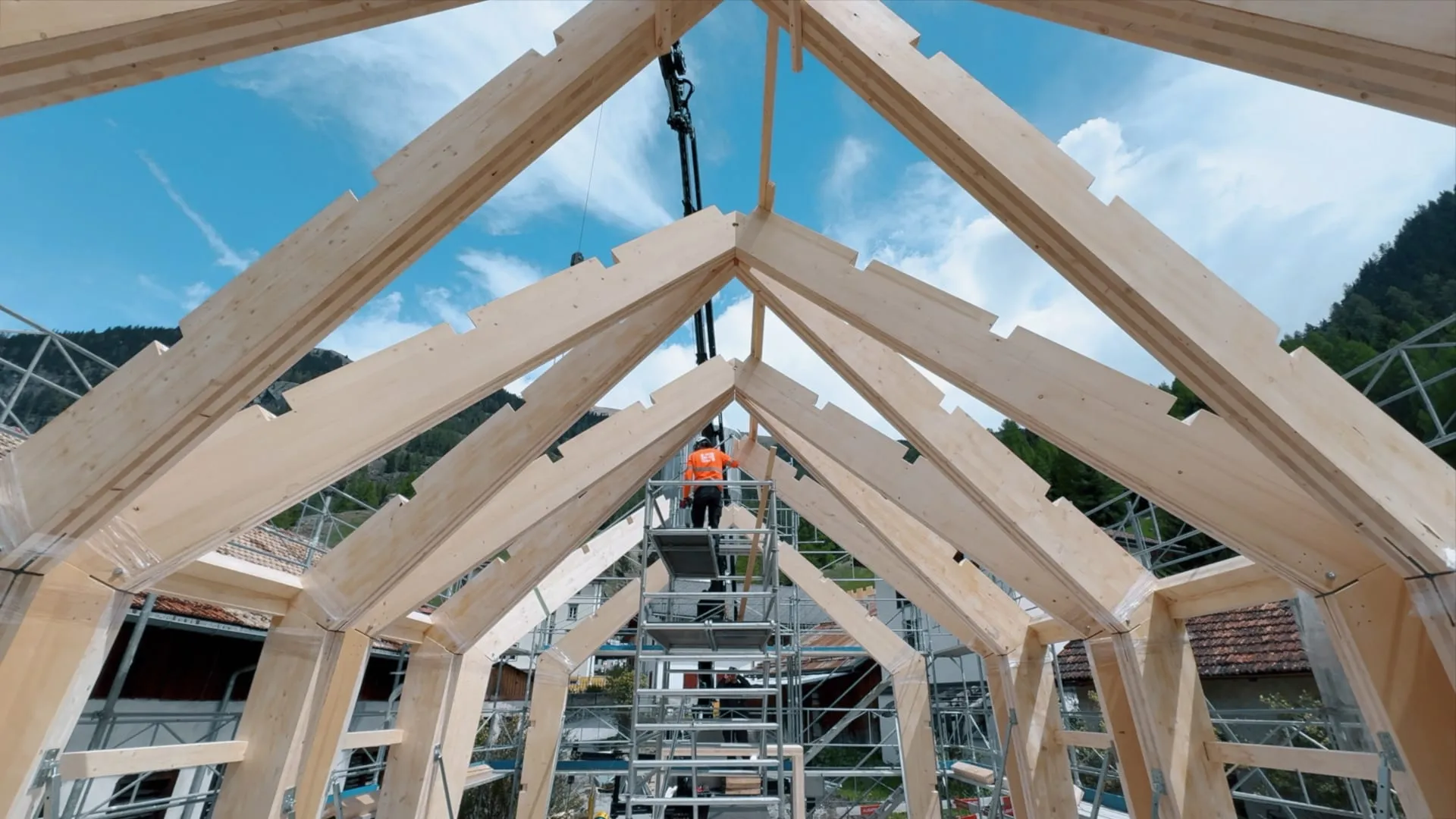
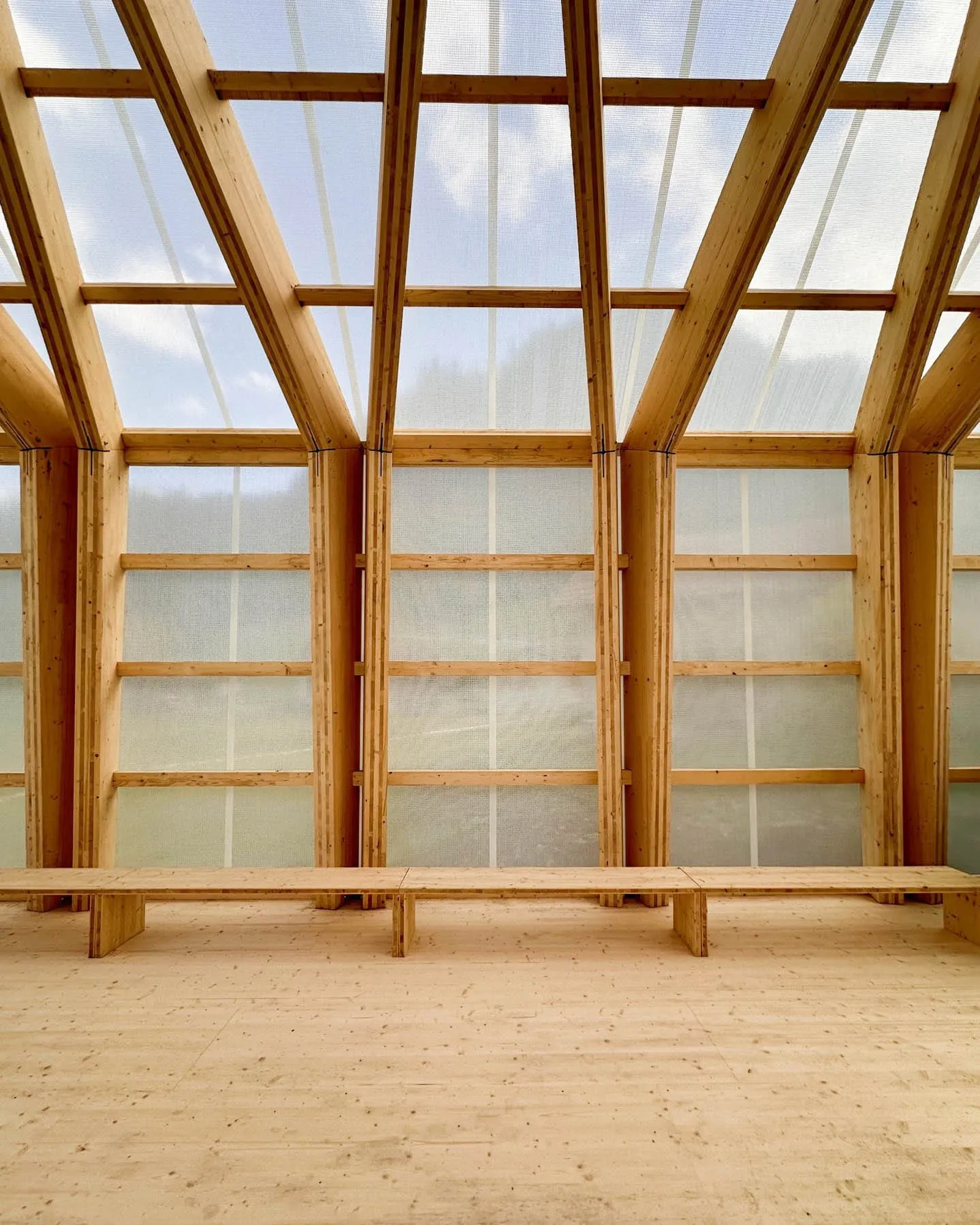
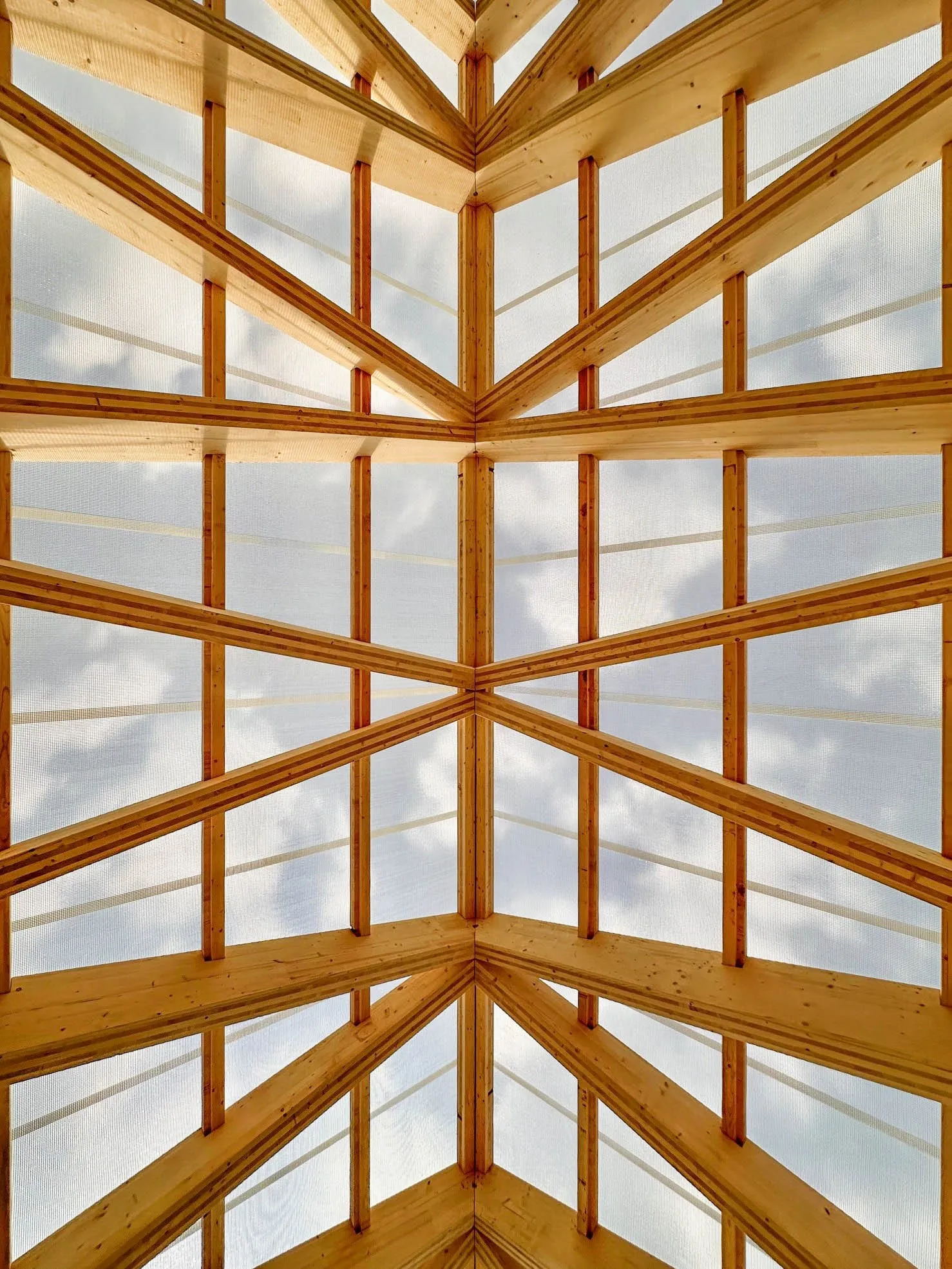
Glatsch is a pavilion in Mulegns, next to Tor Alva, that serves as a small performance space and ice-cream kiosk. It occupies the exact footprint and volume of a former barn and reinterprets this archetype through contemporary spatial and material strategies. A suspended cupola of Hollow-Core 3D-printed (HC3DP) panels hangs within a load-bearing cross-laminated timber (CLT) structure, enclosed by a translucent membrane. The panels cast shifting shadows and give the interior its chromatic atmosphere.
The pavilion was developed over 20 weeks within the Master of Advanced Studies in Architecture and Digital Fabrication (MAS ETH DFAB) and is the first application of HC3DP panels at building scale.
Design
The cupola reinterprets Baroque dome geometries in a digitally designed language. Its geometry derives from contour slices of a digital topography, each extruded vertically into a panel. Ornamentation works on three levels: trigonometric undulations of the base contours, compound sine functions along the lower panel edges for rhythm and stiffness, and attractor-driven displacement of print points embedded directly in the toolpath.
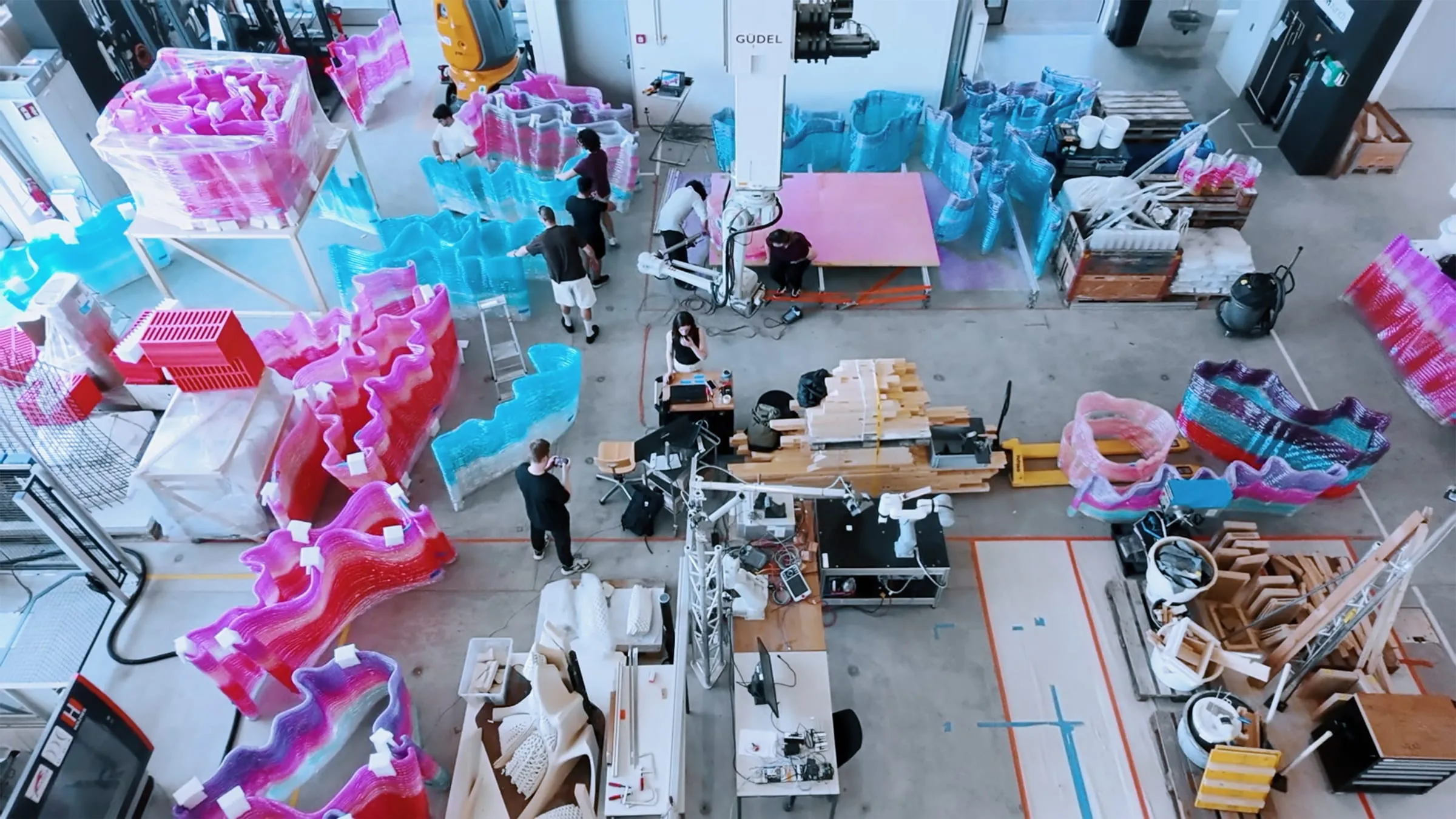
Fixed anchor positions in the CLT ceiling determine the discretisation of the cupola into 54 panels, each suspended by two or three cables. A radial colour gradient runs from warm perimeter tones to cooler tones at the centre, with alternating purple rings for contrast.
Fabrication
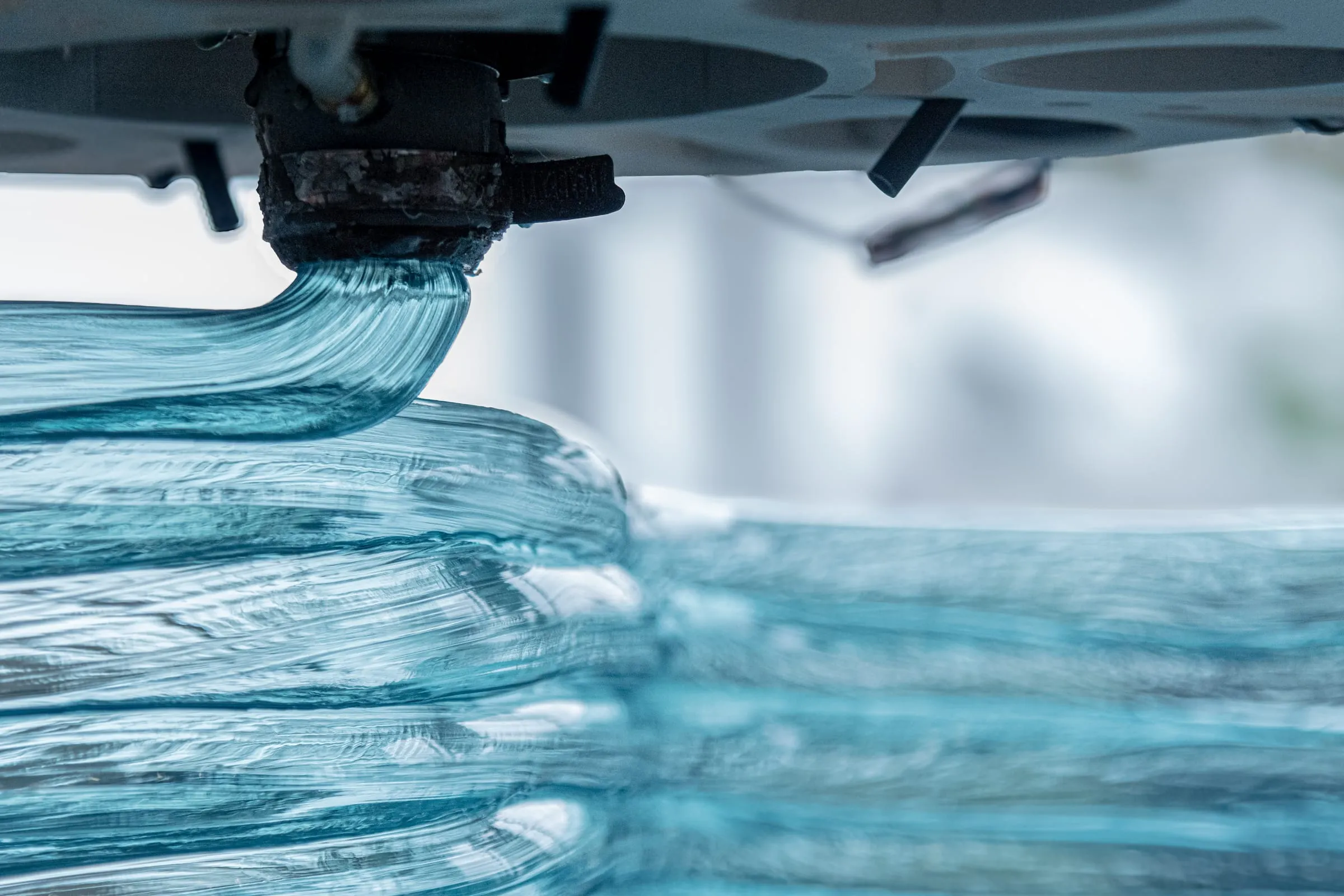
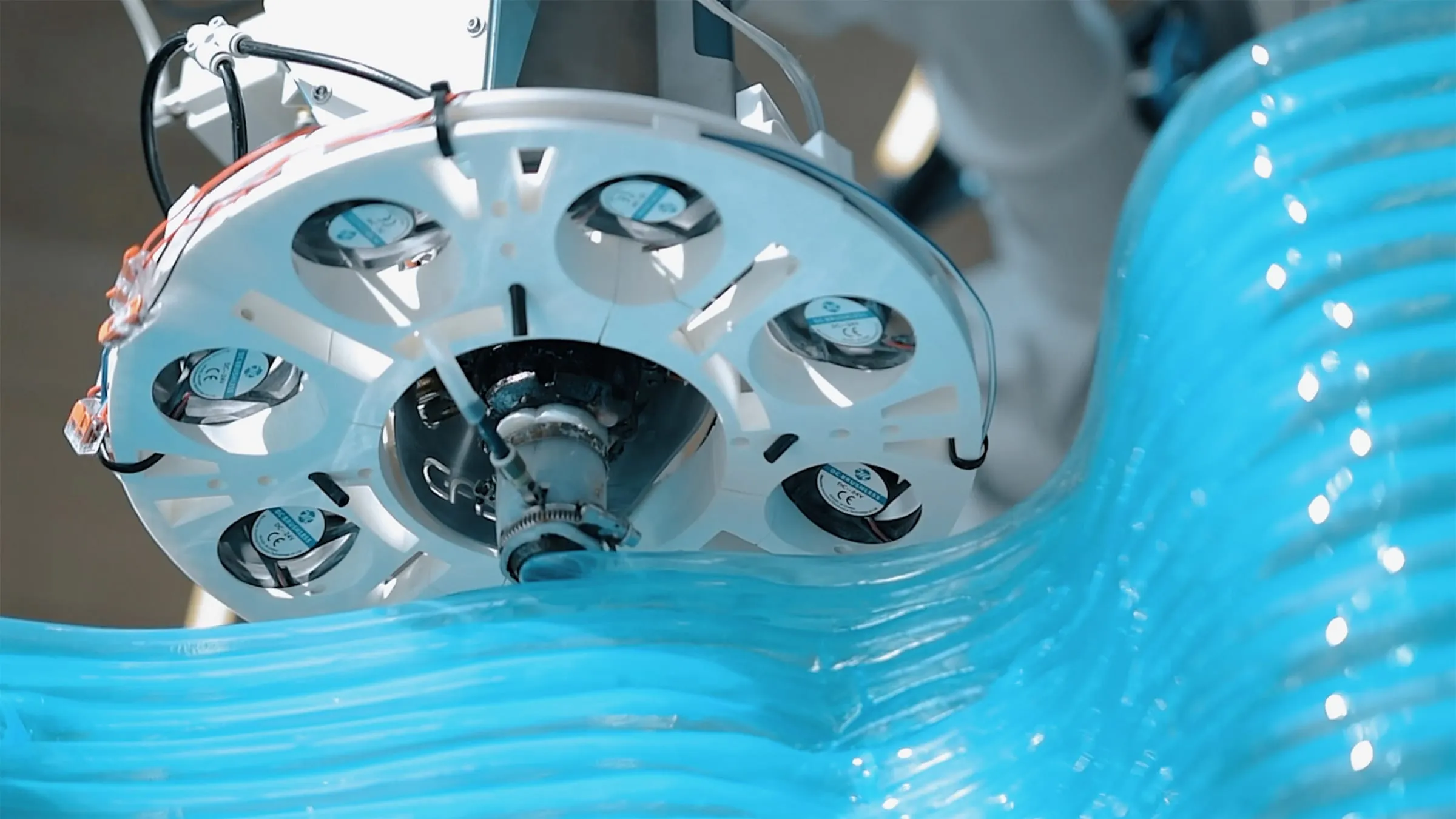
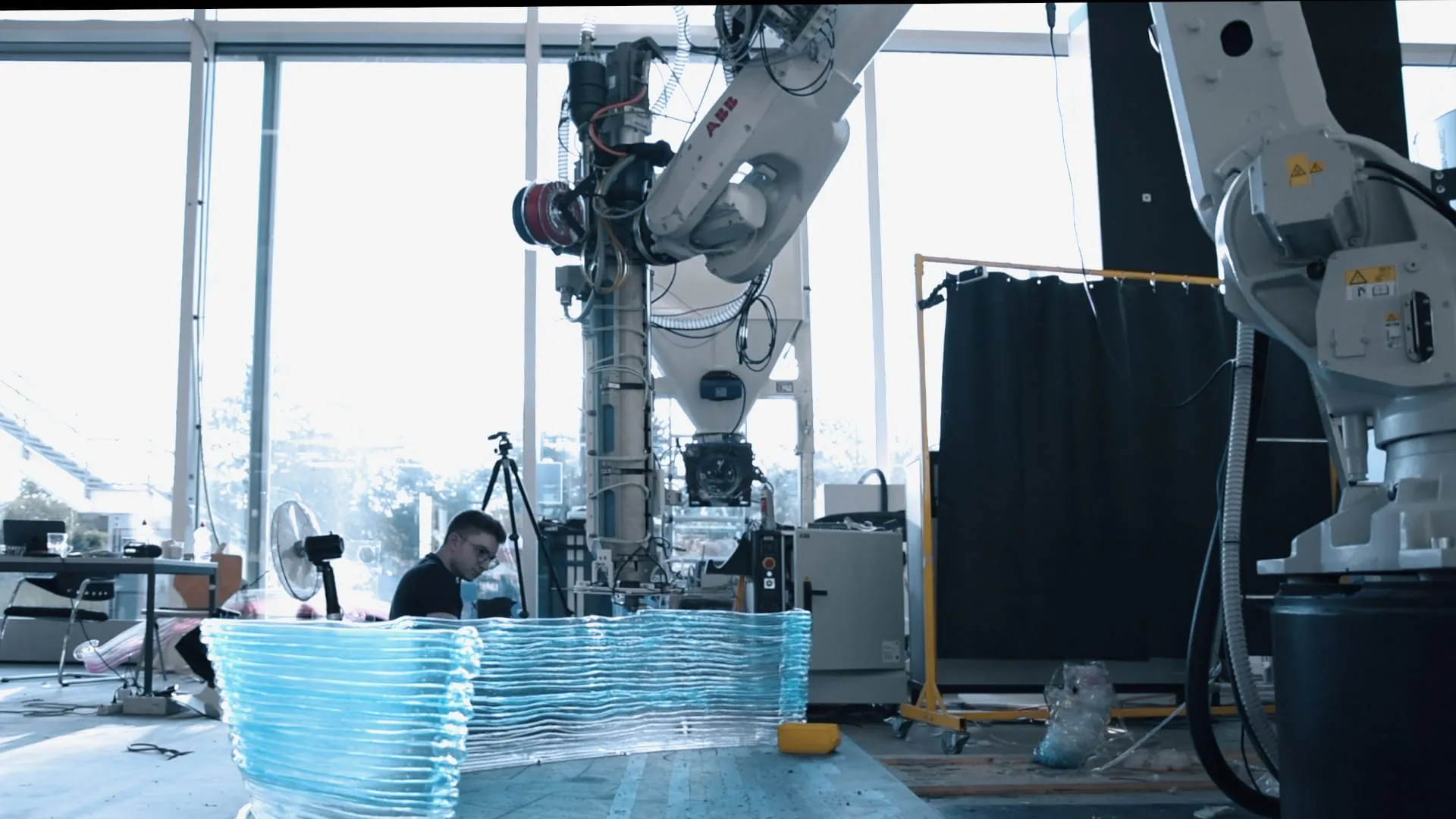
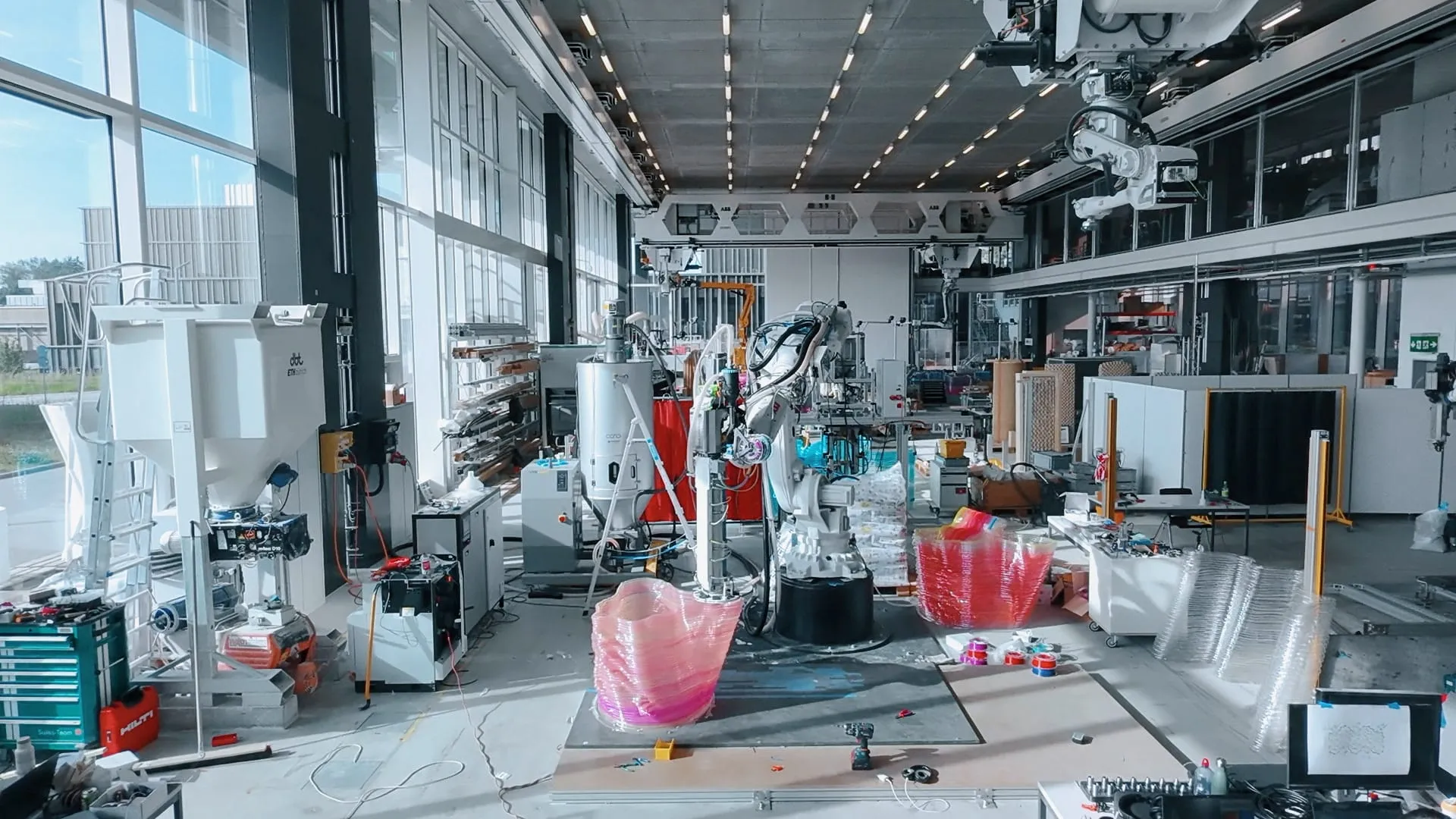
The panels were printed from recycled PETG flakes with a pedestal-mounted ABB IRB 6700 and a CEAD E40 extruder, reaching stable HC3DP at 18 mm/s, three times faster than the prototyping setup. A custom aluminium nozzle produces an air-inflated tubular bead with a layer height of 17.5 mm and a wall thickness of around 0.75 mm.
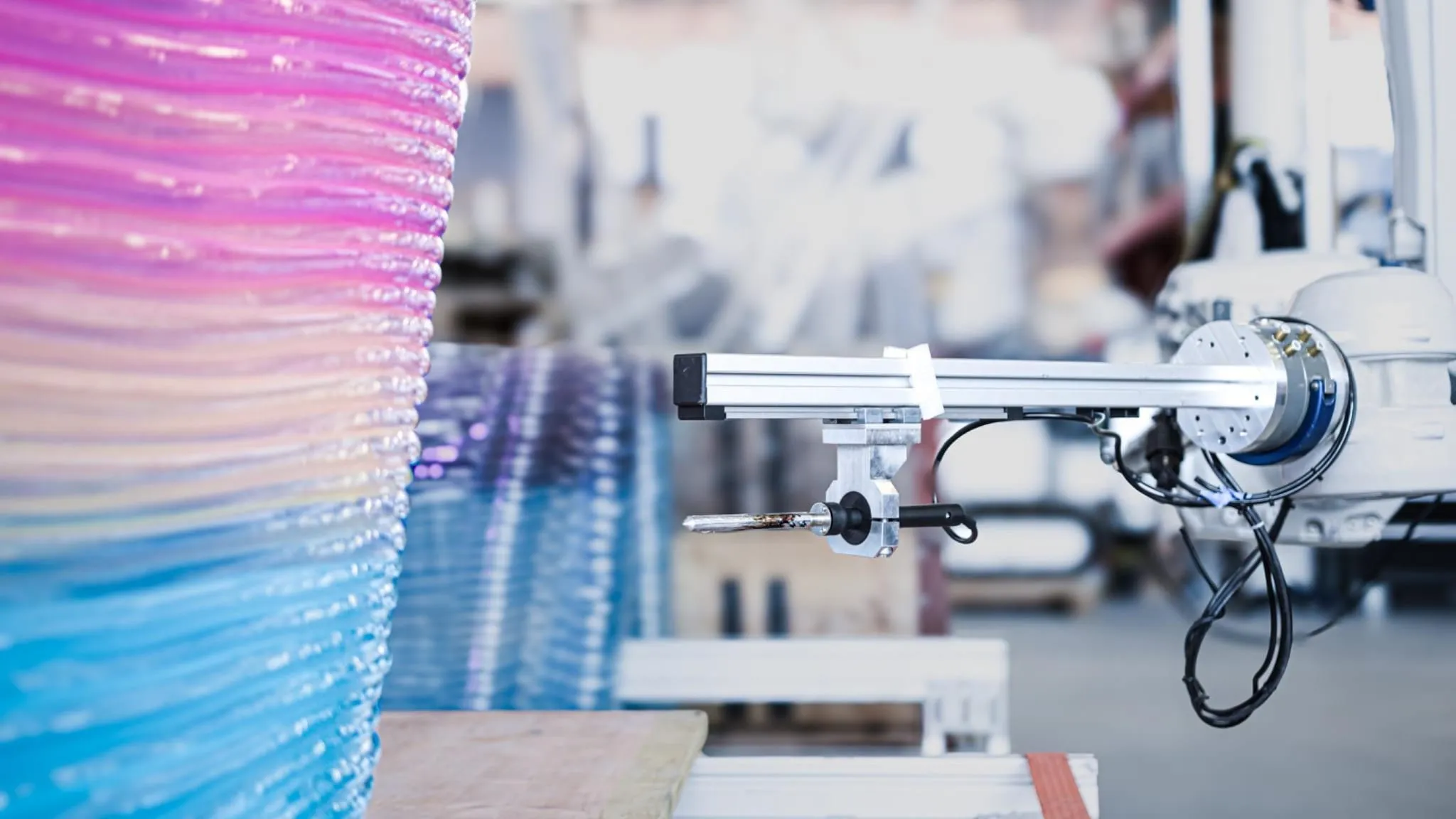
Colour was introduced with a dual-filament injection system developed for the project. Two PETG filaments matching the base material are fed directly into the extruder screw, so the panels remain mono-material and recyclable. Two Boolean signals per print point, written into the toolpath, switch between two colours, their mix and the transparent base.
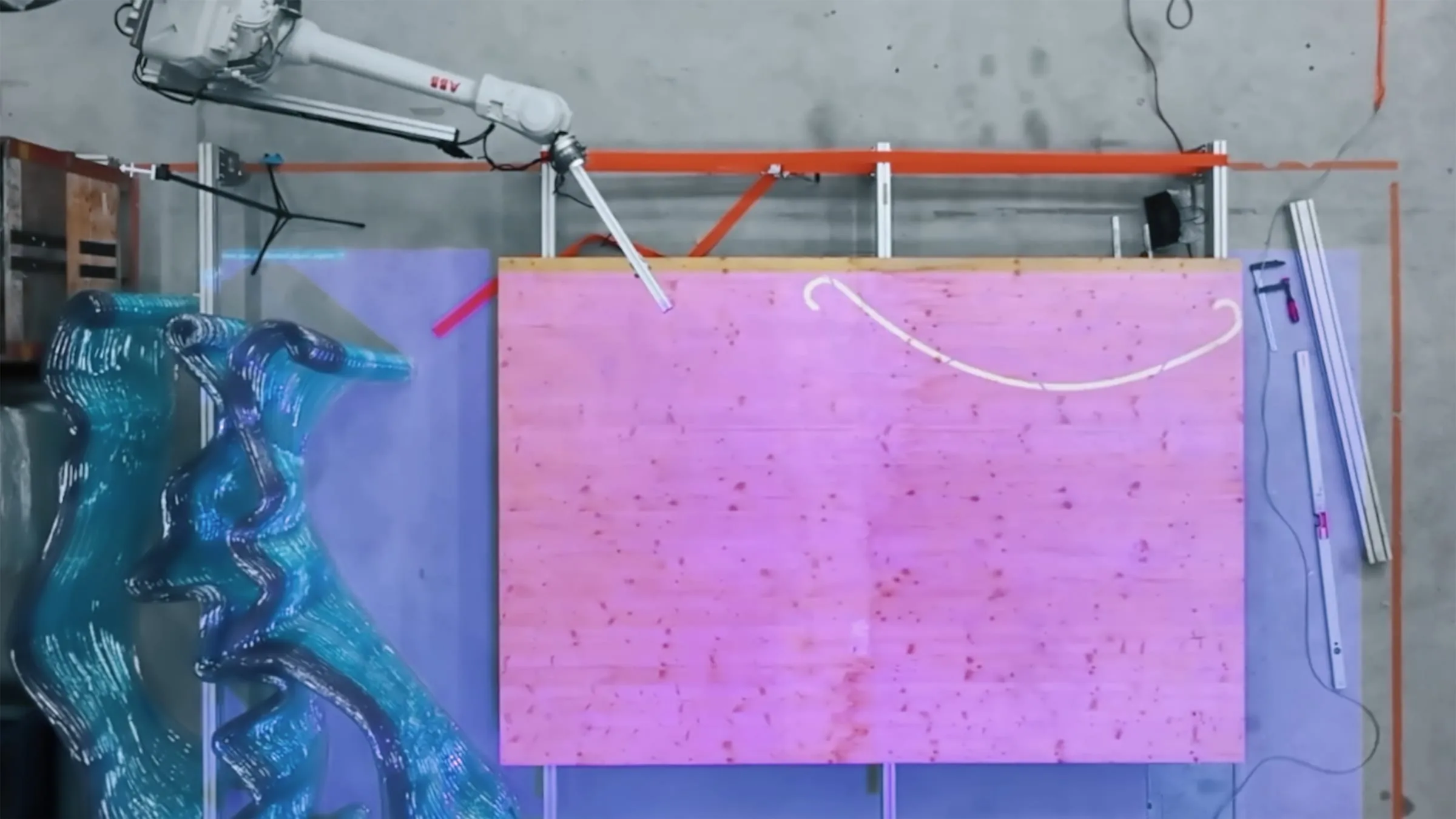
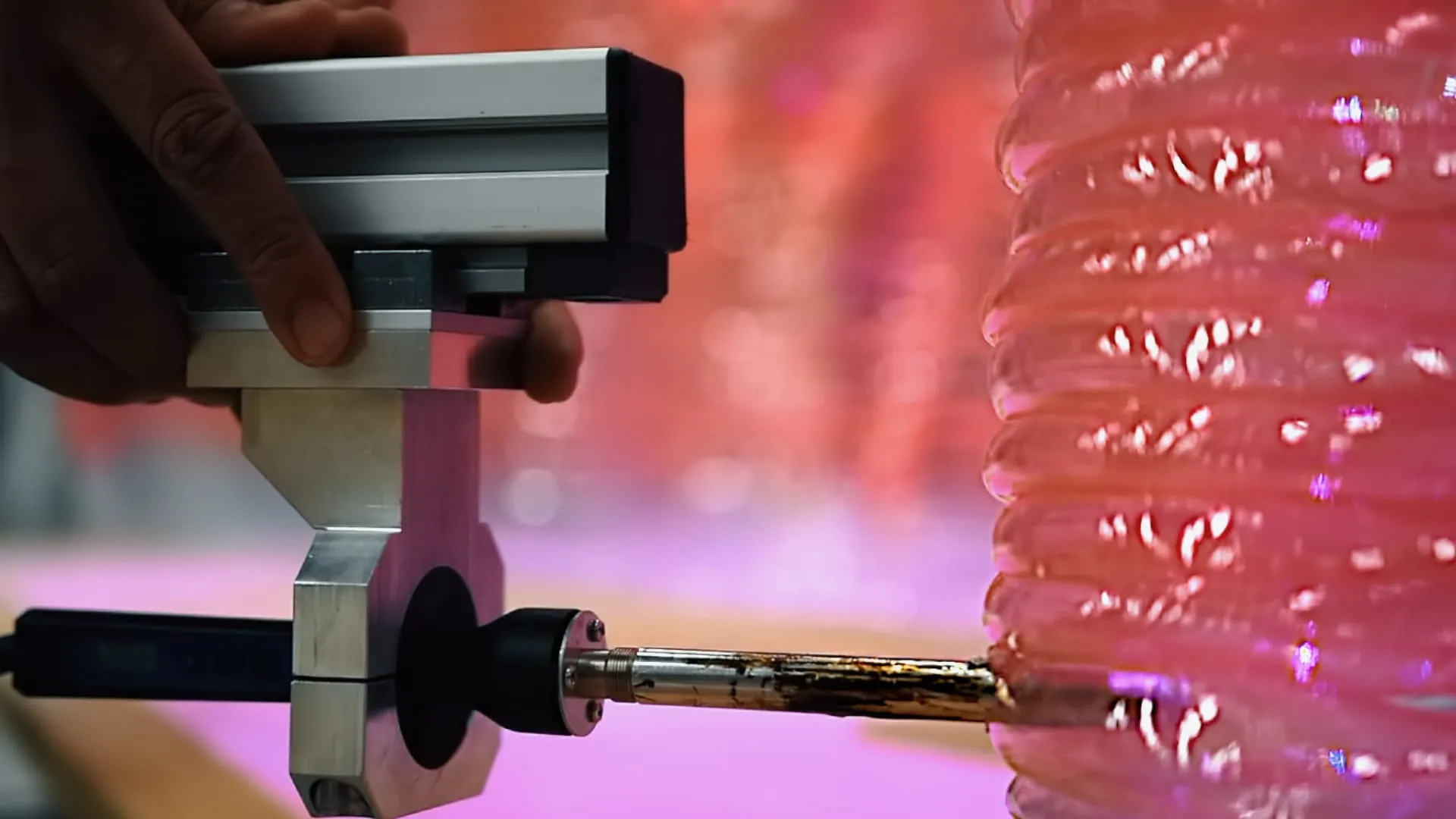
For assembly, a robotic thermo-perforation workstation drilled the suspension holes with a heated conical tool at 130 °C, guided by a 1:1 projection of each panel onto the platform.
Assembly
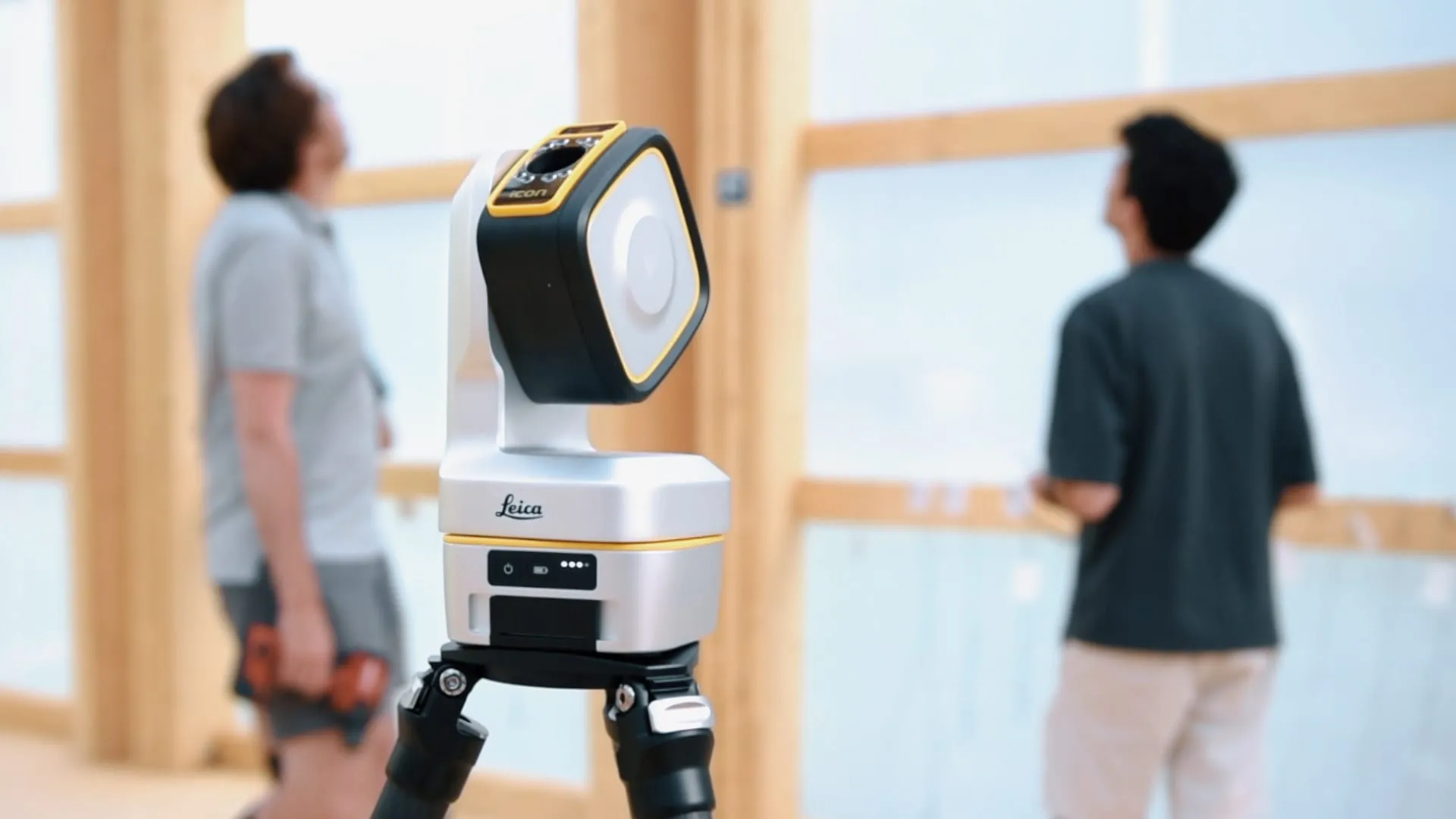
The panels were transported in six modules on two trucks. On site, a total station located the suspension points in the CLT ceiling. Adjacent panels share suspension points, and all connections are dry and reversible, so the timber and polymer components can be dismantled and reused or recycled.
Key figures
- 54 HC3DP panels, about 0.98 t of recycled PETG, covering 250 m²
- Pavilion 7 × 12 m, maximum interior height 7 m
- Panel weight 12.8 to 26.4 kg, 18.1 kg on average
- 170 hours of robotic printing, about 3 hours per panel
- Five filament colours: turquoise, red, magenta, yellow and navy blue
My contribution
Research lead for Digital Building Technologies.
Credits
MAS ETH DFAB 2024–25 students: Alim Battal, Nicolas Benjamin Boscoboinik, Guillem H. Camarasa, Jim Chen, Lais Hotz, Konstantina Laki, Daniela Larbaleister, Yen Ting Liu, Pluem Pongpisal, Spyros Pyrgiotis, Marc Ribert Arqués, Dalila Romero Zenker, Ioanna Tatouli, David Villegas.
Teaching team: Dr. Petrus Aejmelaeus-Lindström (project lead), Ananya Kango, Joana Tomaz.
Digital Building Technologies: Prof. Benjamin Dillenburger, Nik Eftekhar Olivo (research lead), Paul Jaeggi.
Commissioned by: Nova Fundaziun Origen (Giovanni Netzer) and UFFER Group (Enrico Uffer).
Construction partners: Invias AG (Zindel United), Battaglia Bau AG, Poltera Holzbau AG, Tokyoblue GmbH, Brasser AG Veranstaltungstechnik, Bieri Tenta AG.
Robotic Fabrication Laboratory: Philippe Fleischmann, Tobias Hartmann, Michael Lyrenman, Luca Petrus and the RFL team.
Playing the video loads content from YouTube. Open on YouTube
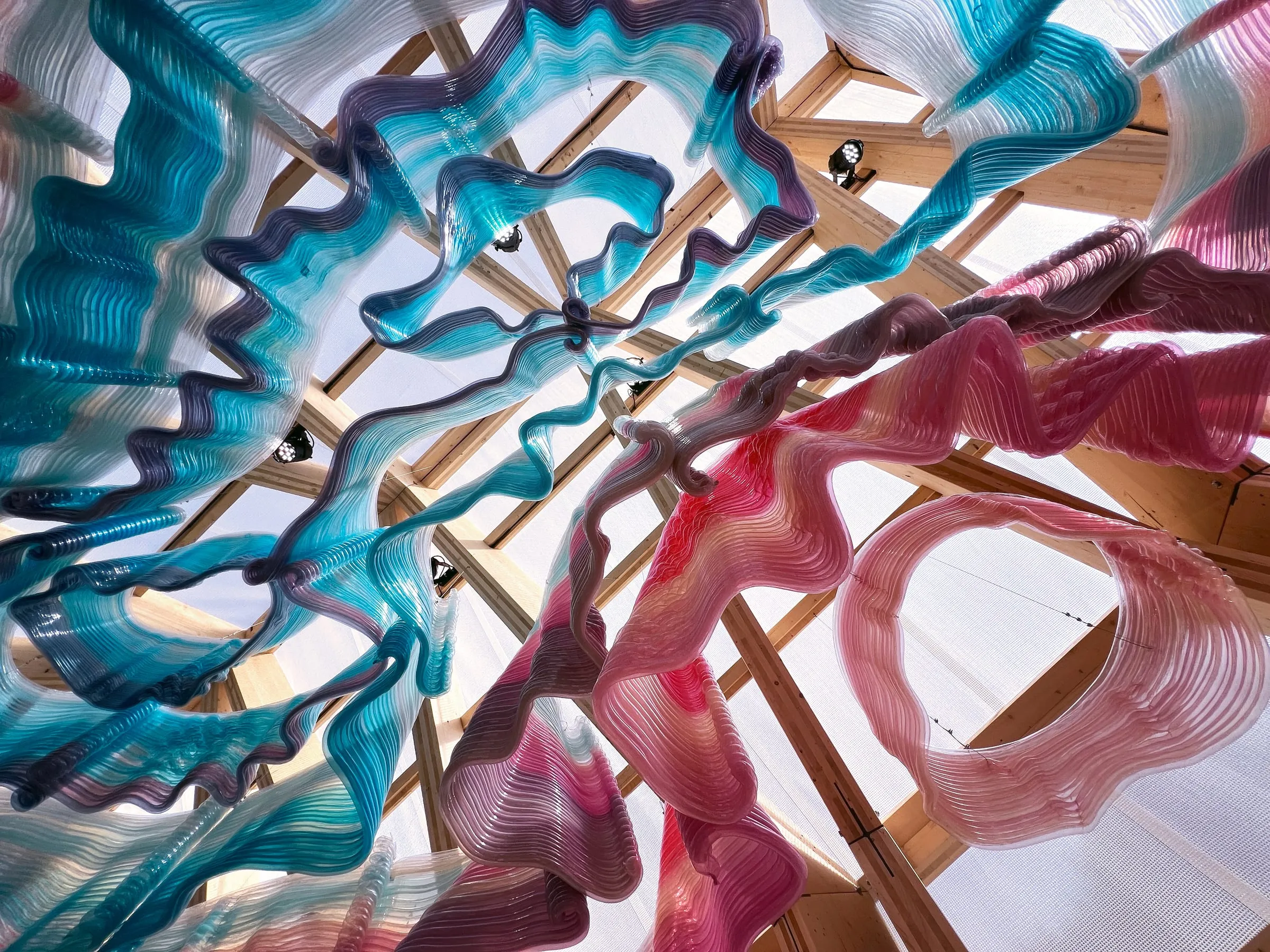
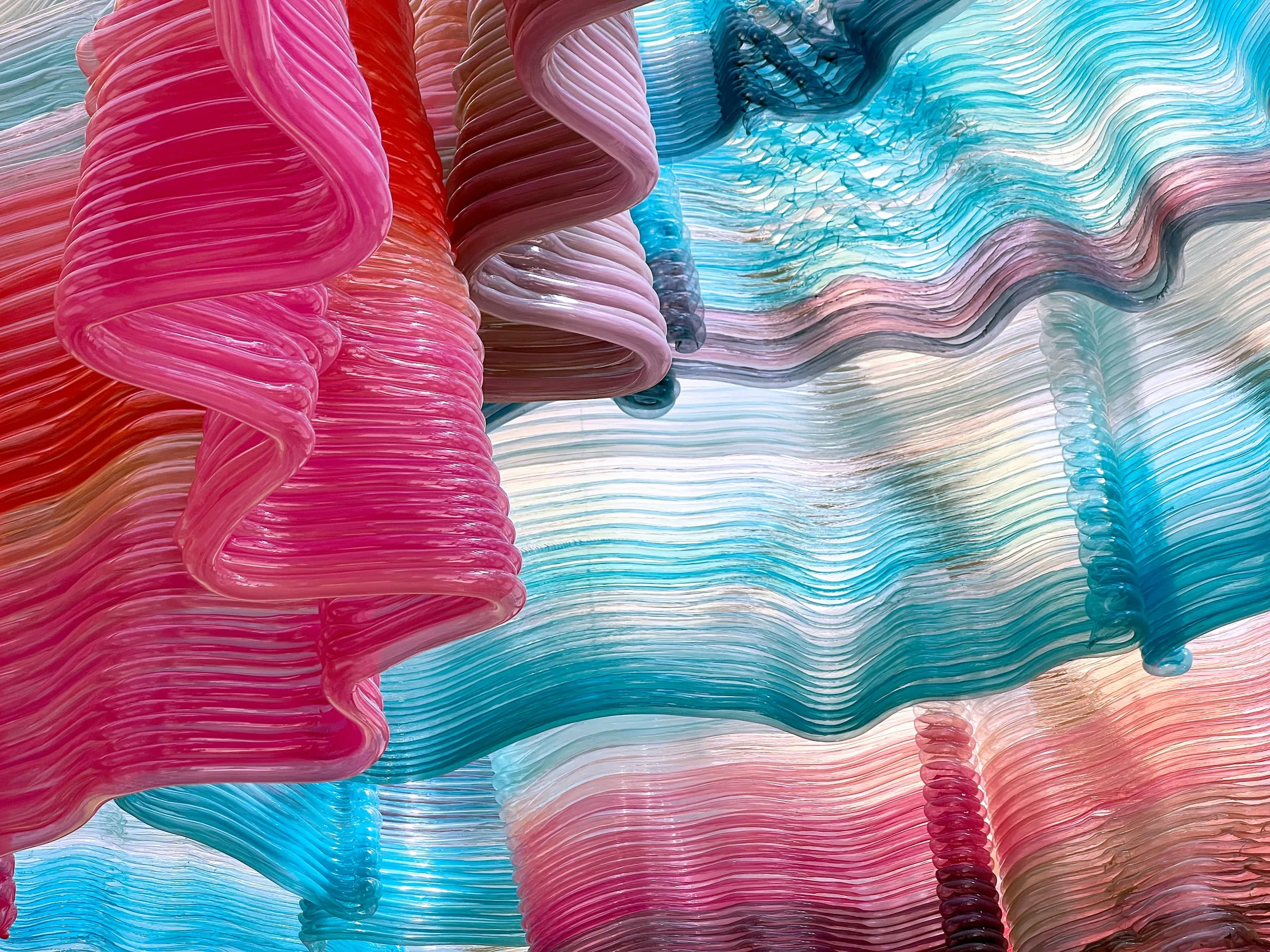
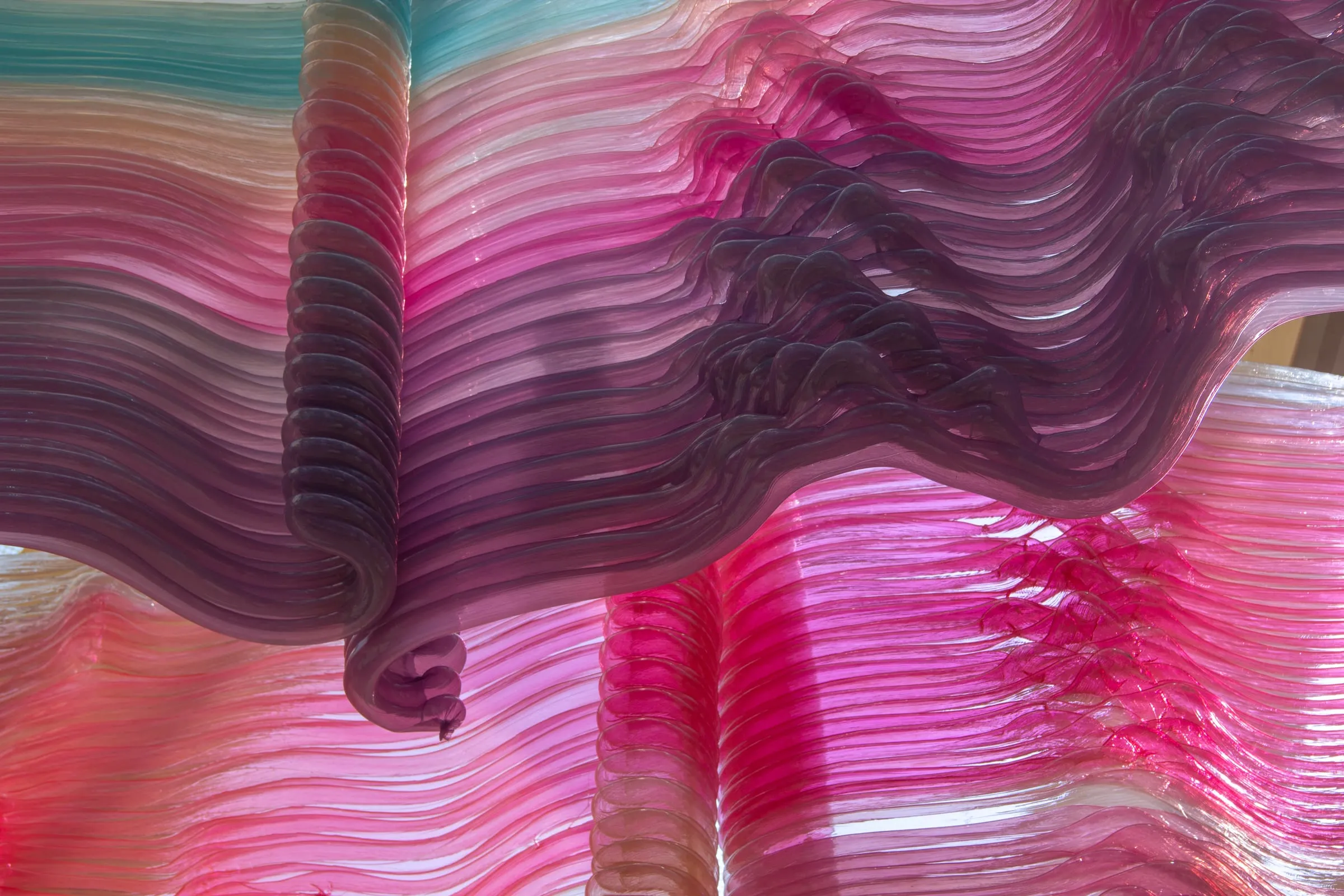
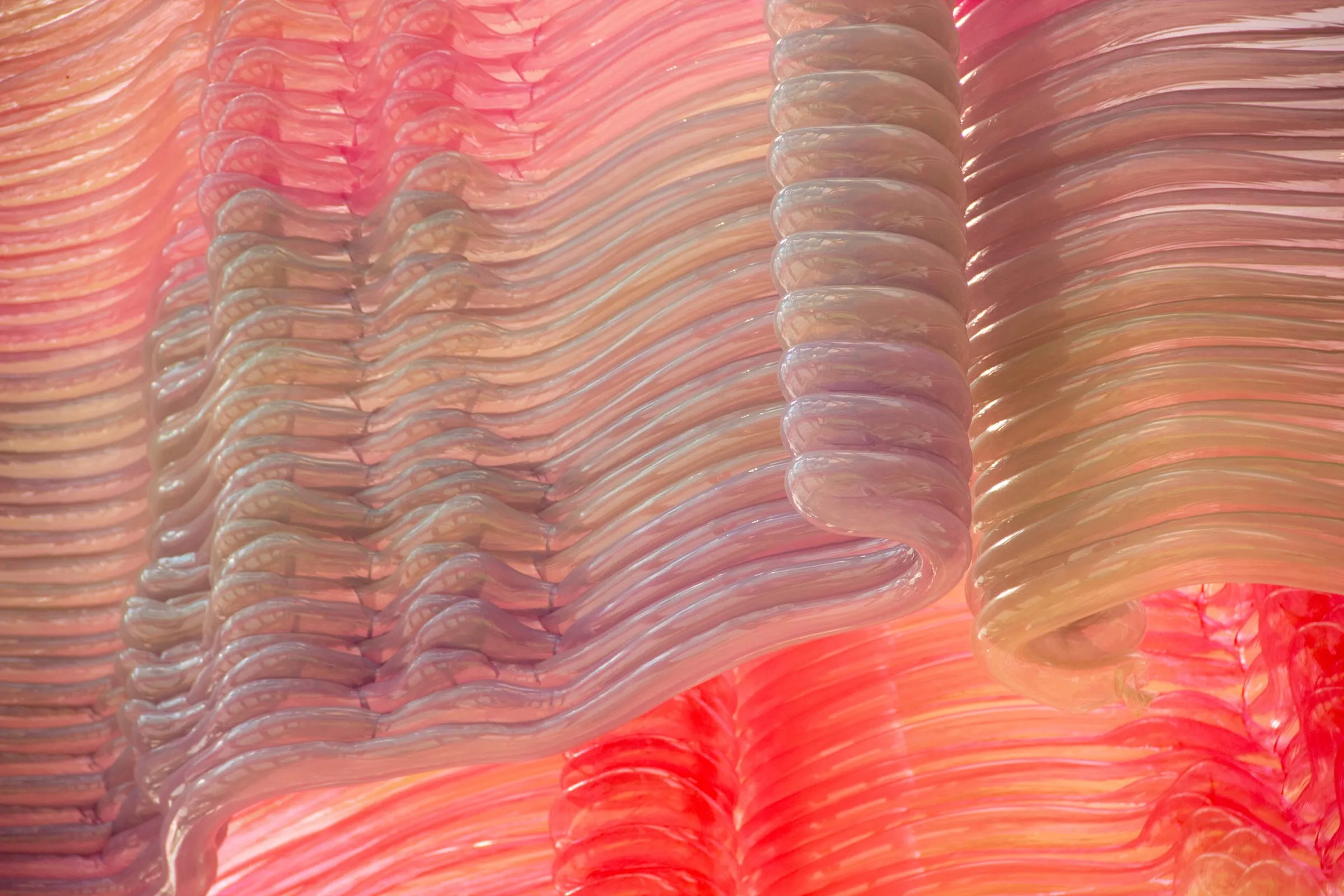

Photos: Nik Eftekhar Olivo, Ananya Kango, Lais Hotz, Pluem Pongpisal, Stefan Kaiser
Publications
- Eftekhar Olivo, N., Kango, A., Jaeggi, P., Tomaz, J., Aejmelaeus-Lindström, P., & Dillenburger, B. (2026). Glatsch: Dual-filament coloring for pellet-based HC3DP and panel robotic thermo-perforation. Proceedings of ACADIA 2026: Humanism Recoded, Detroit.